Today, the Mohammed bin Rashid Space Centre announced on its official X account that the satellite F‑1 will be launched today from Vandenberg Air Force Base in the United States of America.
The centre said that it developed this mission as part of an initiative to host satellite payloads, in cooperation with the United Nations Office for Outer Space Affairs, offering countries and entities the opportunity to test their innovations in space.
F‑1 represents a qualitative step in the UAE’s journey toward opening space access to countries and institutions, and enhancing international cooperation in science and technology. The satellite was fully developed and assembled in Dubai, reflecting the UAE’s vision to invest in innovation and enable international partners to contribute actively to space exploration.
A global platform for space research and innovation
F‑1 is a standardized 12U CubeSat satellite, weighing up to 20 kilograms, with an expected operational lifetime of about one year. It is designed to allow international partners to test and evaluate new technologies in low-Earth orbit.
Through this mission, the Mohammed bin Rashid Space Centre contributes to providing a supportive space environment for research, education, and innovation — enhancing capability development in satellite engineering, data processing, and real-time mission operations.
The satellite hosts a set of innovative payloads that reflect the spirit of international cooperation: a payload dubbed “Amaan” from the Bahrain Space Agency, aiming to test data‑encryption software; a long-range wireless communications system using LoRa technology, from the Nepalese company Antarikshya Pratisthan Nepal; as well as a video camera payload from the centre itself, specialized in space imaging to capture high‑definition photos and videos — intended to provide relevant observation data, support educational programs, and help test and validate future technologies.
Additionally, F‑1 carries a payload named “Luna” from the Sharjah Academy for Space Sciences and Astronomy — an electronic module used to measure temperature and determine satellite orientation.
Developed in the UAE
F‑1 was fully developed at the facilities of the Mohammed bin Rashid Space Centre in Dubai, in cooperation with the partners during the phases of design, testing, and mission preparation. The centre provided full technical support for the integration and verification processes to ensure that all payloads meet their operational objectives.
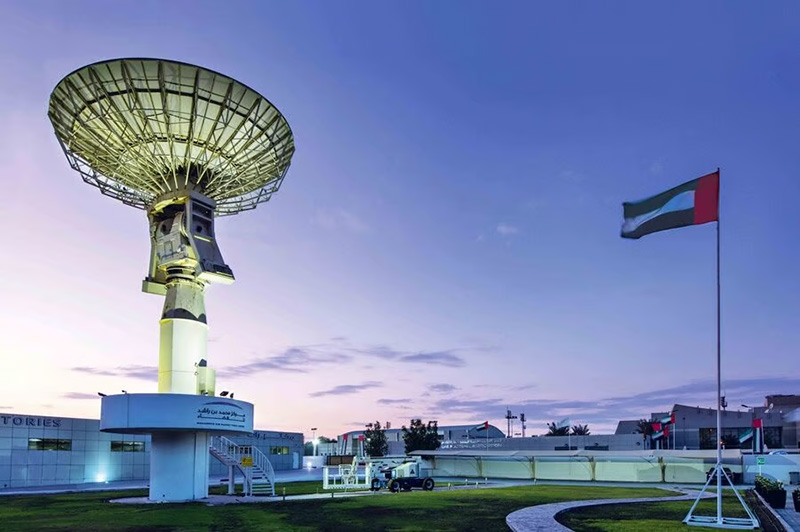
Once the satellite reaches a low-Earth orbit at an altitude of approximately 500 kilometres, it will begin sending data to the control and monitoring station affiliated with the centre, where the data will be analyzed and shared with the participating parties — supporting future research efforts.
This mission embodies the United Arab Emirates’ growing role in building a global space ecosystem based on cooperation and the exchange of knowledge and expertise, reinforcing the use of space for the benefit of humanity.