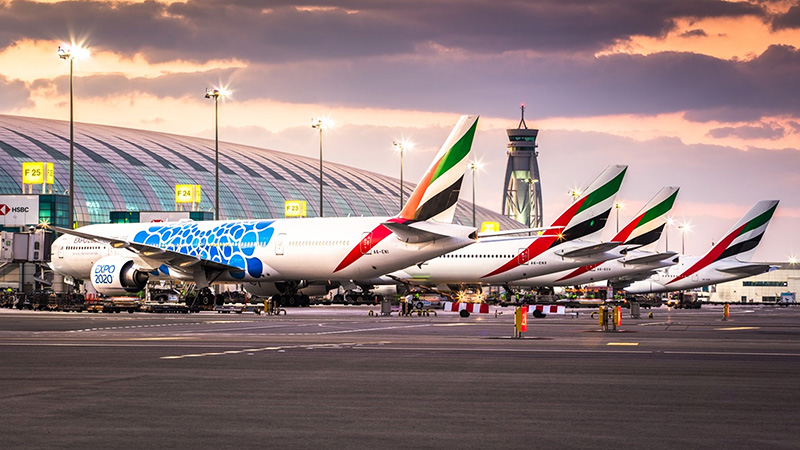
Dubai International Airport has once again confirmed its leading global position after recording more than 4.89 million scheduled seats on outbound international flights during February, bringing the total to 9.78 million seats in both directions, compared to 4.78 million seats in the same month of 2025. This was according to the latest monthly report issued by OAG, the global provider of airport and airline data.
With this strong performance, Dubai International maintained its number one global ranking in total seat capacity (international and domestic), outperforming its closest competitor by a margin of 297,000 seats. The second position was held by Hartsfield–Jackson Atlanta International Airport in the United States, which recorded a capacity of 4.59 million seats, reflecting a modest annual increase of 1%.
Other Airports in Global Competition
The top ten global airports list witnessed notable shifts. Shanghai Pudong International Airport advanced to third place, driven by strong growth of 7%, reaching 4.27 million seats. Meanwhile, Tokyo Haneda Airport slipped to fourth place after a slight annual decline of 1%, with capacity totaling 4.18 million seats.
China’s Guangzhou Baiyun International Airport posted one of the highest growth rates among the top ten, increasing by 15% to 4.16 million seats, securing fifth place. Delhi International Airport followed in sixth position, recording 7% growth to reach 3.87 million seats.
In Europe, London Heathrow Airport remained stable in seventh place with 3.85 million seats, showing little year-on-year change. Chicago O’Hare International Airport re-entered the top ten in eighth place after a strong 15% increase, reaching 3.71 million seats.
Istanbul Airport ranked ninth with a capacity of 3.684 million seats, reflecting moderate growth of 2%, while Dallas/Fort Worth International Airport completed the top ten with 3.682 million seats, unchanged compared to February 2025.
Leadership in International Seat Capacity
Dubai International’s leadership was not limited to overall capacity. The airport also retained its position as the world’s largest airport by international seat capacity alone in February, surpassing London Heathrow, which recorded 3.6 million seats in second place. Seoul Incheon followed with approximately 3.55 million seats, while Singapore Changi and Amsterdam Schiphol ranked fourth and fifth with around 3.4 million and 3.2 million seats, respectively.
Drivers of Growth and Success
This strong performance reflects the sustained momentum at Dubai International Airport since the beginning of 2026, supported by continued growth in international travel demand, the expansion of global air connectivity networks, and an increase in the number of destinations and flights operated by national and international airlines through Dubai.
The achievement, recorded for the second consecutive month, underscores the airport’s strategic role as a global gateway between East and West and a world-class transit hub distinguished by high operational efficiency and expanding capacity, amid intense competition within the global aviation industry, particularly across Asian and North American markets.