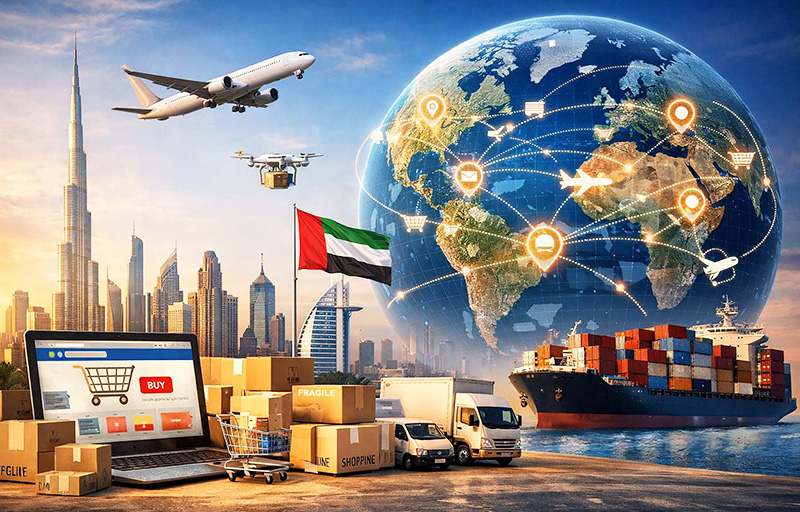
The United Arab Emirates is further reinforcing its status as one of the world’s leading centers for e-commerce, supported by an integrated ecosystem that combines advanced logistics infrastructure, flexible regulations, and rapid digital transformation across government services.
These advantages have positioned the UAE as a key platform for managing digital trade and cross-border e-commerce operations in the region. The country has also become a preferred gateway for global companies seeking to expand into markets across the Middle East, Asia, and Africa.
International reports highlight the UAE as one of the most prepared countries for digital trade worldwide. A report by Standard Chartered indicates that the country ranks among the leading markets in terms of digital trade readiness, thanks to its strong digital infrastructure, clear regulatory environment, and the rapid adoption of emerging technologies by businesses that are reshaping global trade flows.
A study conducted by Euromonitor International in cooperation with EZDubai also revealed significant growth in the UAE’s e-commerce market in recent years. The sector reached a value of approximately AED 32.3 billion in 2024 and is expected to exceed AED 50.6 billion by 2029, representing a compound annual growth rate of about 9.4 percent.
The UAE’s impact extends beyond its domestic market, playing a key role in supporting the expansion of e-commerce across the Middle East and North Africa. According to international estimates, the region’s e-commerce market reached around $34.5 billion in 2024 and is projected to grow to nearly $57.8 billion by 2029, reflecting the accelerating shift toward digital commerce across the region.
Industry experts believe the UAE plays a central role in enabling this regional growth due to its strategic advantages that have positioned it as a major hub for digital supply chains.
Himang Kapoor, CEO of Shipa, the e-commerce arm of Agility Group, stated that the UAE has emerged as one of the most efficient global centers for managing digital trade and cross-border logistics. He noted that the country’s strategic location allows companies to reach more than two-thirds of the world’s population within an eight-hour flight, making it an ideal gateway to the Middle East, Africa, and South Asia.
This geographical advantage is supported by world-class infrastructure. Dubai International Airport handled approximately 2.2 million tons of cargo in 2024, while DP World processed around 88.3 million containers across its global network.
Kapoor explained that the UAE has evolved from a simple transit point into a regional control center for international supply chains, supported by specialized free zones, digital trade platforms, and advanced logistics capabilities.
Investments in digital customs systems and smart logistics platforms have also significantly reduced barriers to cross-border trade. According to Dubai Customs, around 98 percent of customs transactions are now completed electronically. Meanwhile, Dubai Trade’s digital delivery order platform has reduced procedures that previously took up to 48 hours to less than 10 minutes. In Abu Dhabi, digital customs initiatives enabled the clearance of about 72 percent of shipments before arrival by 2024.
These efficiencies directly translate into lower costs, faster delivery times, and greater reliability in international shipping.
Ahmed Kazim, Chief Investment Officer at Tradex, said the UAE is no longer just a traditional trading center but has evolved into a fully integrated platform for managing digital trade both regionally and globally.
He explained that three key factors support this role: the country’s large volume of foreign trade, its strategic geographic location, and the diversity of its trading partners. This strength is further reinforced by a growing network of Comprehensive Economic Partnership Agreements with major economies around the world.
Kazim added that the UAE’s digital customs systems, such as Dubai Trade and the Mirsal 2 platform, have significantly reduced customs clearance times from days to just hours in many cases. Operational data also shows that clearance times in the UAE can be 30 to 50 percent faster compared with some other regional trade corridors.
He concluded that the UAE’s success is not driven by infrastructure alone but by a fully integrated ecosystem that includes flexible regulations, specialized free zones, a strong banking sector, political and economic stability, and early adoption of government digital transformation—factors that continue to strengthen the country’s position as a global hub for e-commerce and digital trade.