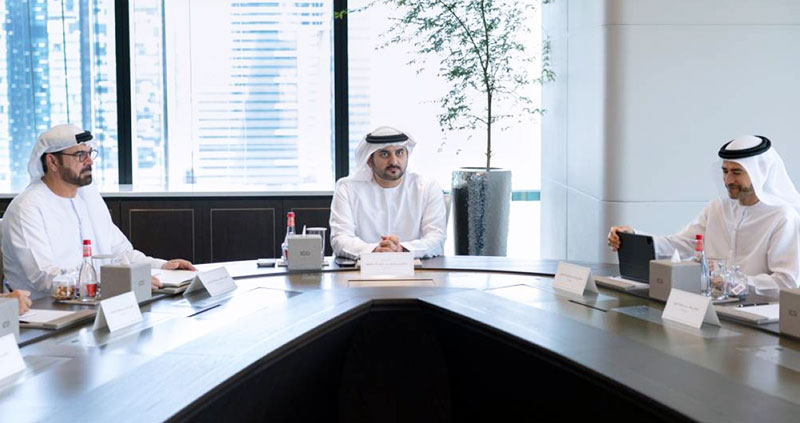
His Highness Sheikh Maktoum bin Mohammed bin Rashid Al Maktoum, First Deputy Ruler of Dubai, Deputy Prime Minister, Minister of Finance, and Chairman of the Higher Committee for the Development of the Economic and Financial Sector, chaired a meeting of the committee to review Dubai’s latest economic and financial performance indicators.
The meeting highlighted the emirate’s progress in global financial competitiveness rankings and examined proposed strategic directions aimed at strengthening Dubai’s position as a leading, fully integrated global gold hub.
His Highness Sheikh Maktoum bin Mohammed bin Rashid Al Maktoum emphasized that Dubai continues to strengthen its economic competitiveness and develop its financial and commercial sectors under the guidance and vision of His Highness Sheikh Mohammed bin Rashid Al Maktoum, Vice President and Prime Minister of the UAE and Ruler of Dubai, may God protect him.
These efforts focus on building integrated economic systems that support sustainable growth and reinforce Dubai’s standing among the world’s leading centers for business, finance, and trade.
His Highness said: “Under the guidance and vision of His Highness Sheikh Mohammed bin Rashid Al Maktoum, we continue Dubai’s journey of diversification and sustainability, strengthening its position as a global hub for business, finance, and trade by developing more competitive economic and financial sectors capable of attracting investment, talent, and international companies.”
Maktoum bin Mohammed Reaffirms Dubai’s Commitment to Economic Competitiveness
During the meeting, the committee reviewed several indicators reflecting Dubai’s continued progress across the economic and financial sectors, including achievements that have strengthened its position among the world’s major international financial centers.
The results highlighted the emirate’s ongoing efforts to diversify its economy, develop its business environment, attract international companies and investment, and expand the contribution of financial and commercial activities to sustainable growth.
Discussions also covered opportunities to build on these achievements and further develop Dubai’s economic and financial ecosystem in line with changes taking place across global markets.
Dubai Ranks First Worldwide in Financial Technology in 2026
Dubai achieved a major milestone by ranking first globally in the financial technology sector in the Global Financial Centres Index released in September 2026.
The emirate moved into the top position after ranking fifth in March of the same year, marking significant progress in just six months.
Dubai also improved its standing in other key categories, rising to second place worldwide in professional services from fourth place previously. In the reputation category, it advanced to sixth place from eighth.
For the fourth consecutive time, Dubai retained its leading position among global financial centers expected to become more significant over the next two to three years.
These rankings reflect continued international confidence in Dubai’s financial sector and its ability to expand its role in the global financial industry.
They also demonstrate the progress Dubai has made in developing its financial services and strengthening its competitiveness in international markets.
Strong Growth in Dubai’s Virtual Assets Sector
Dubai’s virtual assets sector continued to record strong growth, supported by an evolving regulatory environment and increasing activity among licensed service providers.
Figures presented during the meeting showed that the number of virtual asset service providers licensed by Dubai’s Virtual Assets Regulatory Authority had reached 52.
Assets under management in the sector stood at AED 28 billion, while trading volumes recorded by licensed service providers reached approximately AED 7.43 trillion over the previous 12 months.
The figures highlight the rapid expansion of the virtual assets industry in Dubai and the development of a regulatory framework that supports its growth.
They also reflect the emirate’s increasing role in developing an integrated environment for virtual asset services and financial innovation.
Dubai Financial Market Nears AED 1 Trillion in Market Capitalization
The Dubai Financial Market continued to demonstrate positive performance in 2026, with its market capitalization reaching AED 993.1 billion by the end of the third quarter, bringing it close to the AED 1 trillion mark.
Average daily trading activity increased by 24.5%, while institutional trading accounted for 71% of total trading value.
The market also attracted 55,462 new investors during the first nine months of the year. International investors represented 72.1% of these new registrations.
These figures point to a growing investor base and continued international interest in Dubai’s capital markets.
The high share of institutional trading also reflects the significant role played by financial institutions in market activity, alongside the continued participation of investors from around the world.
Dubai International Financial Centre Strengthens Its Appeal to Global Companies
The Dubai International Financial Centre (DIFC) continued to expand its role as a major platform for financial services and international business.
According to the indicators reviewed by the committee, DIFC now hosts more than 10,000 active registered companies, reflecting the continued expansion of its business community.
These include 592 wealth and asset management firms, along with 1,933 companies operating in financial technology and innovation.
The figures illustrate DIFC’s growing ability to attract financial institutions and international businesses seeking to establish or expand their operations in Dubai.
They also highlight the center’s development as an integrated financial ecosystem serving companies and institutions operating across regional and international markets.
Dubai Makes Gold Trade a Key Priority in Its Economic Development
The Higher Committee for the Development of the Economic and Financial Sector also discussed proposed strategic directions to strengthen Dubai’s position as a leading global gold hub.
The discussions included a review of gold sector statistics in Dubai and the UAE, along with proposals for a comprehensive strategy covering the different stages of the gold value chain.
The proposed approach encompasses sourcing, refining, trading, storage, financing, pricing, digital tokenization, and retail activities.
Dubai’s geographic location plays an important role in the sector, connecting gold-producing and supply markets in Africa and Central Asia with major demand centers in India, China, and other international markets.
This position has helped establish the emirate as a key link in global physical gold trading.
Dubai’s Foreign Gold Trade Reaches AED 1 Trillion in 2025
Figures reviewed during the meeting showed that Dubai’s foreign gold trade reached approximately AED 1 trillion in 2025, representing growth of 60% compared with the previous year.
Across the UAE, physical gold trading volumes reached about 2,750 metric tons during the same period, placing the country second globally among physical gold trading hubs.
Dubai also receives between 13% and 15% of the gold traded worldwide each year, highlighting the emirate’s significant role in the international gold market.
The precious metals, gemstones, and diamond ecosystem at the Dubai Multi Commodities Centre (DMCC) includes more than 1,500 member companies.
Meanwhile, the Dubai Gold District, launched in 2026, is home to more than 1,000 gold and jewelry retailers.
The sector has also undergone important institutional and regulatory developments in recent years.
These include the introduction of the UAE Good Delivery Standard and the establishment of the UAE Bullion Market Committee in 2021, followed by the launch of the Dubai Gold District in 2026.
Together, these developments reflect Dubai’s continuing efforts to strengthen the commercial and regulatory infrastructure supporting its gold industry.
Six Strategic Directions to Strengthen Dubai’s Position as a Global Gold Hub
The committee reviewed six proposed strategic directions designed to develop Dubai’s gold strategy and strengthen its role across the international gold market.
The first direction focuses on establishing a fully integrated global gold trading market. It aims to deepen market activity and improve connections among producers, refineries, and buyers across Africa, the Middle East, and Asia.
The second direction seeks to reinforce Dubai’s position as a global center for gold financing. It includes examining opportunities in financing, clearing, collateral, hedging, and institutional gold trading.
The third direction focuses on establishing Dubai as a trusted and neutral location for gold storage by strengthening secure custody capabilities for institutional and sovereign assets.
The fourth direction aims to improve the competitiveness of gold traded through Dubai by developing traceability standards, increasing transparency, and supporting advanced industry practices.
The fifth direction addresses Dubai’s role in gold price discovery. It involves examining tools and platforms that could benefit from the market’s depth and liquidity.
The sixth direction focuses on strengthening Dubai’s position as a global destination for jewelry and final consumer demand, supporting retail trade and making the market more attractive to traders and investors.
These proposed directions cover the major activities associated with gold trading, financing, storage, and retail, reflecting the broader objective of developing an integrated gold industry in Dubai.
Special Committee Established to Oversee Dubai’s Gold Strategy
As part of the efforts to advance the proposed strategy, the Higher Committee approved the formation of a dedicated committee chaired by His Excellency Abdullah bin Damithan.
The new committee will study the proposed strategic directions for Dubai’s gold sector, assess potential initiatives and implementation options, and coordinate with the relevant authorities.
Its responsibilities include identifying initiatives suitable for implementation, defining the roles of participating entities and partners, and proposing an appropriate governance model.
The committee will also develop proposed implementation timelines to support a structured transition from strategic proposals to carefully evaluated initiatives ready for approval.
The approach is intended to strengthen cooperation and coordination between the public and private sectors as Dubai continues developing its gold industry.