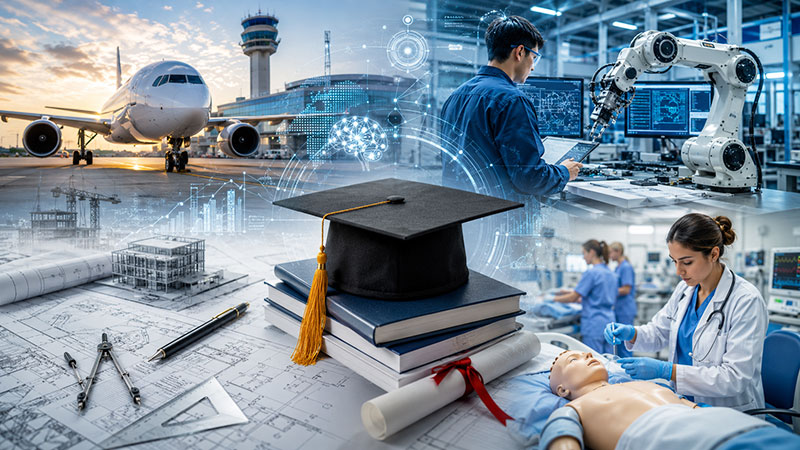
Despite the rapid expansion of digital learning and artificial intelligence applications in universities, applied university majors still top the list of the most expensive academic programs worldwide. Leading these fields are human medicine, dentistry, pharmacy, veterinary medicine, aviation, engineering, architecture, law, international business, and creative arts and design programs.
Experts and academics say these majors have maintained their position not because they are far from digital transformation, but because they depend on elements that technology cannot fully replace. These include specialized laboratories, clinical training, advanced simulation devices, practical experiments, and strict professional accreditation requirements.
AI Has Not Broken the Cost Equation
Artificial intelligence has changed the way teaching and training are delivered in higher education, but it has not changed the core nature of applied programs that require direct practice. Students in these fields do not rely only on theoretical knowledge. They need long hours of hands-on training in fully equipped educational and professional environments.
Current indicators show that annual tuition fees for some human medicine programs can reach around AED 160,000, while fees for some aviation engineering and aircraft maintenance programs range between AED 90,000 and AED 98,000 per year. Meanwhile, the cost of commercial pilot training can rise to much higher levels because of flight hours, simulation training, and professional qualification requirements.
Why Do These Majors Still Have the Highest Fees?
Academics explain that the common belief that digital transformation will lower the cost of university education does not apply to all programs. Theoretical disciplines may benefit more from digital platforms, while applied programs require a complete operational system that includes equipment, laboratories, teaching hospitals, workshops, studios, and safety tools.
Medicine, for example, requires direct clinical training and real interaction with medical cases. Engineering depends on laboratories, experiments, and applied projects. Aviation requires actual training hours and high-precision simulators, along with strict safety and accreditation standards.
In this sense, artificial intelligence has helped reduce the cost of access to knowledge and improve the quality of learning, but it has not reduced, to the same extent, the cost of acquiring accredited professional skills. This remains the most expensive part of these programs.
New Investments in Simulation and Technology
Modern technologies have not always reduced university expenses. In many cases, they have pushed academic institutions to make additional investments in smart simulation systems, virtual reality, digital laboratories, and advanced learning platforms.
Universities offering programs in medicine, engineering, or aviation are required to update their facilities continuously in order to keep pace with rapid changes in the labor market. This includes equipment, software, training systems, and the skills of faculty members.
In medical education in particular, artificial intelligence has become an important tool for analyzing data and medical images and supporting diagnosis. However, it does not replace direct clinical training, because dealing with patients and developing professional skills require real experience and specialized supervision.
Engineering Enters a More Advanced Digital Phase
Engineering programs have witnessed a clear transformation in recent years. They are no longer limited to traditional fields such as mechanical, civil, or electrical engineering. Today, they also include advanced areas such as robotics, artificial intelligence, the Internet of Things, renewable energy, 3D printing, and smart systems.
This development has raised the requirements of engineering education and has pushed universities to establish smart laboratories and provide advanced simulation, design, and analysis platforms. As a result, technology has not directly reduced costs. Instead, it has made the preparation of engineers more dependent on specialized equipment and practical training.
Aviation Remains a Clear Example of High Cost
Aviation is one of the clearest examples of fields that remain expensive despite digital transformation. Preparing pilots and technical aviation staff does not depend only on theoretical study. It requires flight hours, advanced simulators, safety training, and highly specialized professional programs.
Digital transformation in aviation has also created new requirements, such as training on smart aviation systems, data management, predictive maintenance, and modern operating technologies. This means that universities and training centers must continue investing to maintain the quality of their programs and graduates.
Higher Skills for Future Graduates
AI specialists believe that the impact of technology on the most expensive university majors is not limited to changing teaching methods. It also extends to the nature of the skills required from graduates.
The doctor of the future will need to understand smart diagnostic tools. The engineer will need to work with data and digital systems. The pilot will be expected to master more advanced operating technologies.
Therefore, artificial intelligence is not expected to replace humans in these fields. Rather, it will become a partner in professional work. Universities are now moving toward preparing graduates who can use technology responsibly, understand its outputs, and make accurate decisions based on them.
The Majors With the Highest Costs
The list of the most expensive university programs includes several applied and professional disciplines, most notably:
Human medicine, dentistry, pharmacy, health sciences, veterinary medicine, aviation and commercial aviation sciences, aviation engineering, mechanical engineering, robotics, software engineering and artificial intelligence in some advanced technical universities, architecture and architectural design, law, international business and MBA programs, as well as cinema, arts, and creative design.
These programs share several common features: they require advanced learning environments, costly equipment, practical training, and professional accreditation. This explains why they continue to have some of the highest tuition fees.
A Continuing Equation in Higher Education
Although artificial intelligence has brought a major shift to university education, major applied disciplines are still governed by a clear equation: the greater the need for laboratories, field training, simulation, and practical experiments, the higher the cost of the academic program.
For this reason, the high cost of these majors does not reflect tuition fees alone. It also reflects the level of investment needed to prepare doctors, engineers, pilots, and specialists capable of working in precise and vital sectors.