Dubai has maintained its place among the world’s top five maritime shipping centers for the eighth consecutive year, according to the 2026 International Shipping Center Development Index, published by China’s Xinhua News Agency in cooperation with the Baltic Exchange.
The emirate ranked fifth globally while continuing to lead maritime centers across the Arab world, reinforcing its position as one of the key links in international trade and global supply chains.
Singapore topped the global ranking, followed by Shanghai in second place, London in third, and Hong Kong in fourth. Dubai placed fifth with a score of 77.13 points.
The index evaluates 43 international maritime centers based on a wide range of criteria, including port efficiency, specialized maritime services, marine finance and insurance, ship management, legal and logistics services, digital transformation, and the overall business environment.
Jebel Ali Strengthens Dubai’s Global Position
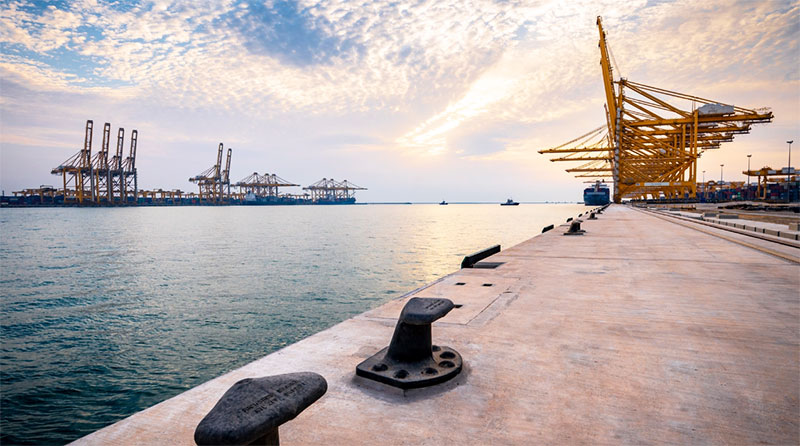
The strong performance of Jebel Ali Port was one of the main factors supporting Dubai’s ranking after the port recorded a new high in container handling during 2025.
Jebel Ali handled approximately 15.6 million twenty-foot equivalent units, compared with around 15.5 million containers in 2024, marking its highest annual throughput since 2015.
This growth reflects the port’s continuing role in connecting regional and global markets, as well as its ability to manage increasing volumes of maritime trade through a broad network of shipping routes and logistics services.
The volume of goods imported and exported through Dubai also rose by about 9% year over year, highlighting the emirate’s expanding role as a center for direct trade in addition to its established position as a transshipment hub.
Non-containerized cargo also posted strong results. Dubai’s ports handled around 1.5 million vehicles during the year, an increase of 18% compared with the previous year, while general cargo volumes reached approximately 5.67 million metric tons.
Expansion Projects Support Operational Growth
The increase in activity across Dubai’s ports was reflected in the financial performance of DP World, which reported record revenue of $24.4 billion in 2025, representing growth of 22%.
The group’s profit also rose by 32% to $1.96 billion, supported by the expansion of maritime and logistics operations and stronger activity across several international markets.
DP World increased its capital expenditure to $3.1 billion to support expansion projects and raise capacity at Jebel Ali Port. The investment also covered the development of Drydocks World and the continued expansion of the group’s maritime and logistics network.
These investments are helping improve operational efficiency and increase the ability to accommodate expected growth in trade volumes, while also strengthening supply chain resilience in response to global changes.
Sustainability Becomes Part of Port Competitiveness
The Xinhua-Baltic Index highlighted the steps Dubai is taking to build a more sustainable maritime transport and logistics system.
As part of these efforts, DP World launched electric freight transport operations in March 2025 in cooperation with Swedish technology company Einride. The initiative is designed to reduce emissions and improve the efficiency of cargo movement within Jebel Ali Port.
The number of electric vehicles operating inside the port increased from 14 at the end of 2024 to 146 by October 2025.
Once fully completed in 2026, the system is expected to reduce carbon emissions by more than 14,600 tons annually, equivalent to removing over 2,200 cars from Dubai’s roads each year.
The project is also expected to become the largest autonomous electric freight network in the Middle East once it is fully operational.
As part of its environmental commitments, DP World reduced Scope 1 and Scope 2 emissions by 14% compared with 2022 levels. At the same time, 67% of the electricity used across the company’s operations came from renewable sources.
An Integrated Maritime Ecosystem
Dubai’s maritime strength is not limited to the scale of operations at Jebel Ali Port. It also extends to an integrated network of services that includes marine finance and insurance, ship management, arbitration, legal services, and advanced logistics solutions.
This level of integration gives Dubai a stronger ability to attract international companies and provide multiple services within a connected business environment, supporting its position as a maritime center that goes beyond the traditional role of a port.
The emirate also strengthened its international presence in 2025 by hosting several major maritime events.
In September, Dubai hosted the World Maritime Day Parallel Event in cooperation with the International Maritime Organization under the theme “Our Ocean, Our Obligation, Our Opportunity.” Officials and industry experts took part in discussions on decarbonization, alternative fuels, and the future of sustainable ports.
Dubai also hosted Seatrade Maritime Emirates in May 2025. The event attracted more than 9,000 participants and maintained its position as one of the largest maritime and logistics gatherings in the Middle East and North Africa.
Growing Competition Among Global Maritime Centers
The report noted that continued expansion at Jebel Ali Port, increased investment in dry docks, and the development of maritime services give Dubai a strong foundation to maintain its competitiveness and narrow the gap with the world’s four leading maritime centers.
Dubai’s continued presence among the global top five reflects a clear shift in its role, from a regional transshipment hub to a global maritime platform that combines trade, financial and logistics services, innovation, and sustainability.
The progress also shows that competition among maritime centers is no longer based only on cargo volumes. It increasingly depends on service quality, digital transformation, infrastructure efficiency, and the ability to reduce emissions while supporting the future of global trade.
Ranking of the World’s Largest Maritime Shipping Centers in 2026
- Singapore: 99.32 points
- Shanghai: 84.27 points
- London: 81.80 points
- Hong Kong: 80.87 points
- Dubai: 77.13 points
- Ningbo-Zhoushan: 71.09 points
- Rotterdam: 70.22 points
- New York/New Jersey: 69.50 points
- Athens/Piraeus: 68.76 points
- Hamburg: 67.36 points
The index results confirm that Dubai continues to strengthen its presence in the global maritime shipping sector, supported by Jebel Ali Port’s record performance, growth in foreign trade, and continued investment in expansion and sustainable technologies.