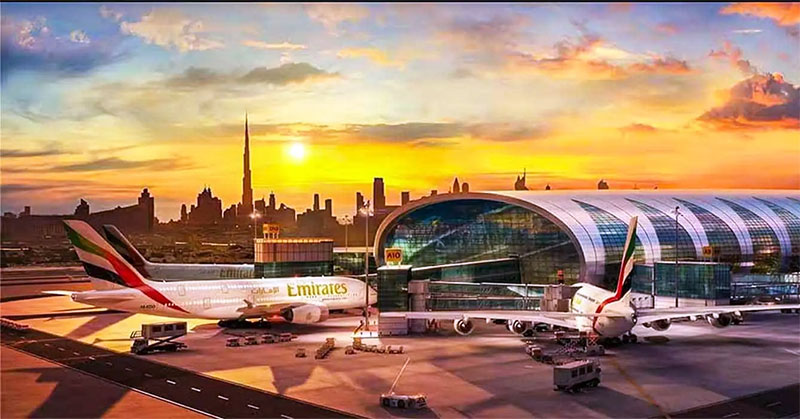
Dubai International Airport continued to strengthen its position at the top of global aviation in October 2026, maintaining first place among the world’s busiest airports in terms of scheduled international seat capacity.
According to data from OAG, the international organization specializing in airport and airline data, airlines operating at Dubai International scheduled around 4.57 million seats on international flights during October, equivalent to approximately 9.15 million seats in both directions.
The figures reflect the continued strength of international travel through Dubai and the airport’s position as one of the world’s leading air transport hubs.
Strong Growth in Dubai International’s Capacity
Scheduled international capacity at Dubai International Airport rose to around 4.57 million seats in October, compared with approximately 4.34 million seats in September.
This represents an increase of about 230,000 seats in one month, or monthly growth of roughly 5.3%.
The increase comes as airlines continue to expand their operations through Dubai, whether by adding more flights to existing destinations or extending their networks to new markets.
The monthly growth also reflects continued momentum in passenger demand for international travel through the airport.
Dubai Stays Ahead of London Heathrow
Dubai International maintained its lead among the world’s 10 largest international airports by scheduled seat capacity, remaining ahead of London Heathrow, which ranked second.
London Heathrow recorded around 4.12 million international seats in October, leaving a gap of approximately 450,000 seats compared with Dubai International.
Seoul Incheon Airport in South Korea ranked third with about 3.94 million seats, while Amsterdam Schiphol Airport came in fourth with approximately 3.72 million seats.
Singapore Changi Airport moved into fifth place with around 3.68 million international seats during the month.
The figures show Dubai International maintaining a clear lead over some of the world’s largest and most prominent international airports.
Strong Presence From European and Asian Airports
European and Asian airports continued to feature prominently among the world’s 10 busiest international airports by seat capacity.
Istanbul Airport ranked sixth with approximately 3.56 million seats, followed by Paris Charles de Gaulle Airport in seventh place with around 3.47 million seats.
Hong Kong International Airport moved up to eighth place with about 3.46 million seats, while Frankfurt Airport ranked ninth with around 3.39 million seats.
Bangkok Airport completed the top 10 with approximately 2.76 million seats during October.
The rankings reflect strong competition among major international aviation hubs, while Dubai International continues to hold the leading position.
Dubai International as a Key Hub Between East and West
Dubai International Airport continues to reinforce its role as a major hub for air travel between East and West, supported by a broad network of destinations and flights connecting Dubai with global markets.
Dubai’s strategic location, together with its aviation infrastructure, supports the airport’s position in international travel and strengthens its role in connecting passengers across different regions of the world.
This position is further supported by Emirates and flydubai, both of which use the airport as a major base for their operations.
The two airlines continue to expand their networks by launching new destinations and increasing flight frequencies to existing markets.
The airport also benefits from the operations of other international airlines that serve Dubai International, giving passengers a wider range of travel options and strengthening air connectivity through one of the world’s leading aviation hubs.
95.2 Million Passengers in 2025
Dubai International Airport maintained its position in 2025 as the world’s largest airport by international passenger numbers for the 12th consecutive year.
The airport welcomed around 95.2 million passengers during the year, representing growth of 3.1% compared with the previous year and making 2025 the busiest year in the airport’s history.
The performance reflects continued growth in international travel through Dubai and the airport’s ability to maintain its leading position among the world’s largest airports.
A Network Connecting Dubai to 217 Global Destinations
Passenger traffic at Dubai International remained strong in 2026, supported by the continued return of airline operating capacity and rising travel demand.
During the first six months of 2026, the airport welcomed 31.5 million passengers as travel activity continued to grow and airlines expanded their operations.
By the end of the first half of the year, Dubai International was serving 50 international airlines and providing connections to 217 destinations across 99 countries.