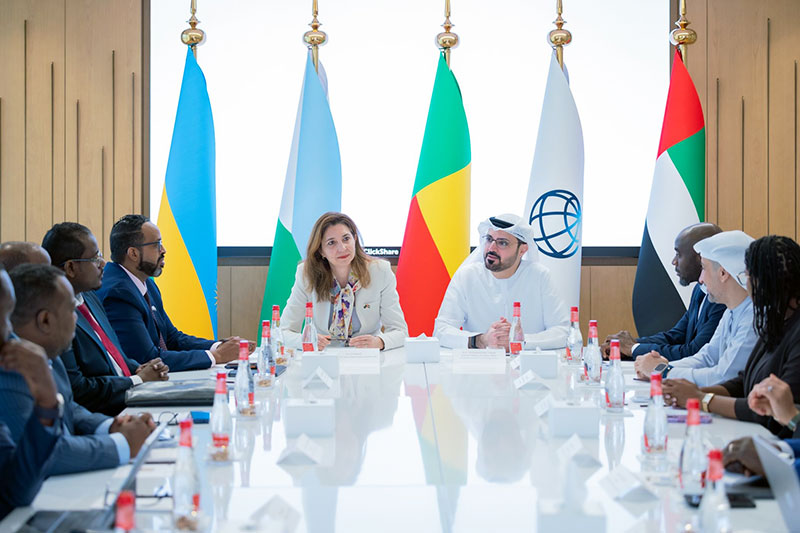
The UAE Government, in cooperation with the World Bank, has launched the first cohort of the “Government Knowledge Exchange Program on Zero Bureaucracy,” aimed at strengthening government capacity in a number of African countries, including the Republic of Benin, the Republic of Djibouti and the Republic of Rwanda.
The program gives participating countries an opportunity to learn from the UAE’s experience in government modernization and development, and to benefit from its approaches and expertise in improving government work. It also seeks to turn shared knowledge and experience into practical initiatives that help simplify procedures, enhance services and improve government performance.
The program comes as part of the partnership between the UAE Government and the World Bank, which aims to expand cooperation in public administration, enhance government efficiency and reduce administrative burdens and complexities faced by citizens, businesses and government employees.
An International UAE Partnership to Advance Government Work
The initiative reflects the UAE’s commitment to sharing its government expertise with partner countries and making use of international cooperation to develop public administration systems through the exchange of experiences, methodologies and knowledge in government modernization and procedural simplification.
The program is based on direct engagement with national teams in participating countries, helping them identify their actual needs and reform priorities before using available knowledge and expertise to develop solutions that can be implemented and measured.
Al Gergawi: People Are at the Heart of Government Development
His Excellency Mohammad Abdullah Al Gergawi, Minister of Cabinet Affairs, affirmed that the UAE leadership has established an advanced government approach that places people at the center of government work and makes their well-being the ultimate purpose of development. He said this approach reflects the leadership’s vision of building a government that anticipates society’s needs, works to simplify people’s lives, improves the quality of services, accelerates delivery, and turns challenges into opportunities for development and innovation.
His Excellency noted that the partnership between the UAE Government and the World Bank reflects this direction and represents a strategic platform for transferring expertise and methodologies to partner governments, not merely as an exchange of knowledge, but as an integrated path for building national capabilities and enabling government teams to lead change and develop solutions themselves.
His Excellency also emphasized the commitment, through this partnership, to identifying challenges, understanding the priorities of each government, and working with national teams to turn knowledge and expertise into practical and implementable initiatives based on measurable performance indicators and clear plans. He said this would strengthen governments’ ability to continue developing, achieve tangible and sustainable improvements in the quality of life of their communities, and make knowledge exchange a genuine partnership in shaping the future rather than simply transferring an experience from one country to another.
This vision highlights the UAE’s focus on linking government development with practical results that directly benefit individuals and businesses, while strengthening the ability of government entities to respond to challenges and develop more efficient and flexible solutions.
World Bank: Bringing the UAE Experience to African Partners
For his part, Ousmane Dione, World Bank Vice President for the Middle East, North Africa, Afghanistan and Pakistan, said the visit reflects the shared commitment to bringing the UAE’s experience in the Zero Bureaucracy Program to partners in Africa.
He added that through knowledge exchange, the two sides are working together to support governments in simplifying procedures, improving the quality of government services and placing individuals and businesses at the heart of government work, considering these essential pillars for creating more jobs and delivering tangible results.
The program therefore strengthens cooperation between the UAE Government and the World Bank in supporting governments seeking to develop more efficient systems, improve the experience of people using public services and create a more flexible environment for business and investment.
Government Leaders From Benin, Djibouti and Rwanda Take Part
The first cohort of the program included ministers and senior government officials from Benin and Djibouti representing sectors including digital transformation and innovation, economy and finance, budgeting and public service, development finance, urban affairs, health and government information systems, helping expand the exchange of expertise in government modernization and the simplification of procedures and services.
The delegation from the Republic of Benin included Minister of Digital Transformation and Innovation Mahouna Akplogan, Presidential Adviser Irina Gbaguidi, Director at the Ministry of Digital Transformation and Innovation Arcadius Chokpodou, and Anzir Adimi Junior, Head of E-Services and Platforms at the National Agency for Information Systems and Digital Technology.
The delegation from the Republic of Djibouti included Secretary-General of the Ministry of Urban Affairs Abdulkarim Hassan, Secretary-General of the Ministry of Health Mohammed Ali Mohammed, Secretary-General for Digital Economy and Innovation Abdullah Ibrahim Omar, and Director-General of the National Agency for State Information Systems Mustafa Mohammed Ismail.
The delegation from the Republic of Rwanda included Secretary-General of the Ministry of Information Technology and Innovation Eraste Rurangwa and Innocent Asimwe, Head of Operations and Strategy at the Information Society Authority.
15 Meetings, Specialized Sessions and Workshops
The program featured 15 meetings, specialized sessions and workshops, as well as meetings with UAE experts, giving participating delegations an opportunity to learn about the UAE’s experience in zero bureaucracy and discuss ways to simplify and improve government services and procedures.
The meetings also addressed methods for community participation in service development, practices related to financial efficiency and improved government performance, as well as the exchange of international experiences and best practices in government modernization.
These sessions created a practical setting for direct knowledge exchange between officials and experts, helping participants better understand the challenges facing each country and develop solutions suited to their national needs.
90-Day Action Plans
The sessions, workshops and meetings focused on helping each country identify a priority reform challenge and develop a national action plan covering a period of 90 days.
The plans include identifying the entities and officials responsible for implementation, establishing clear performance indicators and defining the stages for follow-up and evaluation, helping turn the program’s outcomes into practical and implementable measures.
This approach is designed to ensure that the program’s impact continues beyond the training and specialized sessions by moving acquired knowledge into practical implementation within participating government entities.
Learning From Uzbekistan’s Experience
The program also included a virtual knowledge exchange session with the Government of the Republic of Uzbekistan, allowing participating delegations to learn from another country’s practical experience in implementing zero bureaucracy initiatives.
The session gave participants an opportunity to examine key lessons learned and challenges encountered during implementation, as well as the mechanisms used to turn procedural development initiatives into programs that can be implemented and monitored.
This international dimension broadens the program’s scope by enabling participating countries to learn from multiple experiences and identify approaches that best suit their own needs.
Role of the Government Knowledge Exchange Office
The Government Knowledge Exchange Office is responsible for designing the knowledge exchange experience in coordination with the World Bank and participating countries, while providing UAE expertise and methodologies in zero bureaucracy and government service development.
The office also coordinates the participation of UAE government entities and experts, organizes sessions, visits and specialized meetings, and supports national teams in selecting priority challenges and preparing action plans.
Its role also includes providing strategic advice throughout the implementation and follow-up stages, helping government teams move more effectively from learning to execution.
World Bank’s Role in Supporting Participating Countries
The World Bank is responsible for coordinating with beneficiary countries, providing international expertise, specialists and team leaders, and helping align the program with the national priorities of each participating country.
Its responsibilities also include supporting regional follow-up and the exchange of best practices, connecting participating country teams with relevant technical expertise, and contributing to the preparation of implementation plans and the measurement of results.
These responsibilities reflect the nature of a partnership that combines the UAE’s experience in government development with the World Bank’s international expertise in institutional reform and public administration.
National Teams to Lead Reform Efforts
Each participating country formed a national working team, identified priority government challenges and procedures, and provided the data and information required to assess the current situation.
The national teams are responsible for preparing action plans, identifying the entities and officials in charge of implementation, approving performance indicators and timelines, and monitoring the implementation of reforms in coordination with the Government Knowledge Exchange Office of the UAE Government and the World Bank.
This approach strengthens the ability of participating countries to develop solutions rooted in their own national circumstances while benefiting from the UAE and international expertise available through the program.
A Partnership Launched in Washington to Improve Government Efficiency
In April 2026, the UAE Government launched a partnership with the World Bank in Washington, D.C., aimed at strengthening cooperation to empower governments and improve the efficiency of public administration and government work.
The partnership covers several areas, including the exchange of global best practices and methodologies in simplifying procedures and achieving zero bureaucracy, building institutional capacity and transferring knowledge to priority countries.
It also includes supporting the digitalization of the government sector, simplifying regulatory frameworks and developing performance-based governance frameworks, while making use of international platforms to strengthen dialogue and exchange experiences and engaging governments, citizens and businesses in efforts to simplify procedures.