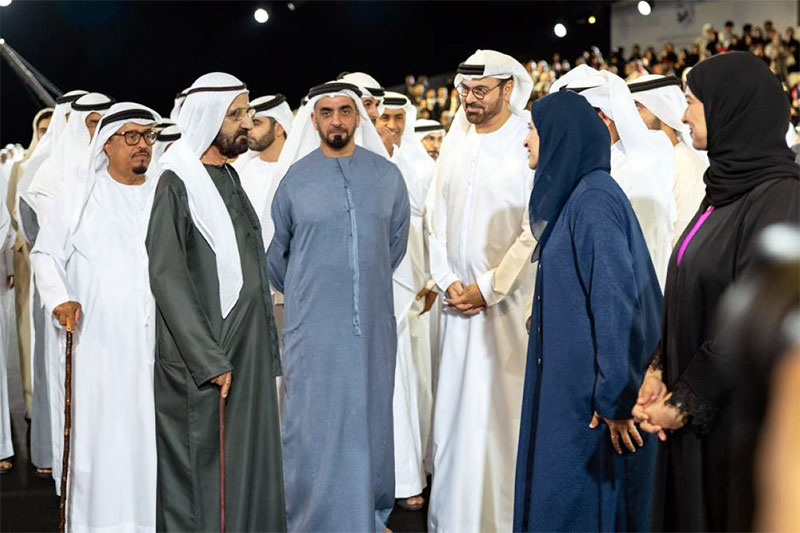
His Highness Sheikh Mohammed bin Rashid Al Maktoum, Vice President and Prime Minister of the UAE and Ruler of Dubai, may God protect him, crowned Egyptian student Mayar Mohammed Ragab Othman the winner of the 10th Arab Reading Challenge during a ceremony held at the Dubai World Trade Centre.
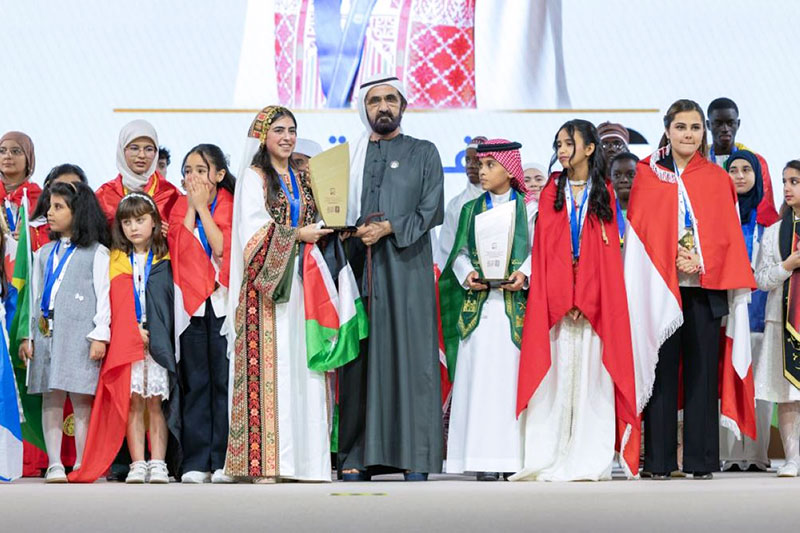
The ceremony was attended by His Highness Sheikh Hamdan bin Mohammed bin Rashid Al Maktoum, Crown Prince of Dubai, Deputy Prime Minister and Minister of Defense, and Chairman of the Executive Council of Dubai.
The event also honored winners across several categories, including Outstanding Supervisor, Outstanding School, the Communities category and the People of Determination category, along with students who secured top positions in the participating countries.
His Highness Sheikh Mohammed bin Rashid Al Maktoum said, “The Arab Reading Challenge is a civilizational project in which we placed our faith in students… and in science and knowledge… with the aim of building a generation that is culturally aware… and excels academically and intellectually.”
His Highness added, “More than 40 million students in the tenth edition have proven that educated people are the true strength in a world taking new shape… We congratulate our nation on these promising generations, and our journey to develop human potential continues without a ceiling or limits.”
In a post on X, His Highness said, “Today, I attended the events of the Arab Reading Challenge in its tenth season… the largest reading competition in the world… More than 40 million students from 138,000 schools in sixty countries around the world participated. Congratulations to student Mayar Othman from the Arab Republic of Egypt on winning first place in the tenth season…
And to student Ghazal Rashad from Palestine in second place and student Rayan Al Zakri from the Kingdom of Saudi Arabia in third place. Congratulations to all participating students and all supervisors, numbering more than 161,000…
They joined us in spreading a culture of reading among new Arab generations… A generation that promises a bright future… A generation that inspires optimism… and renews hope for the revival of civilization.”
The ceremony was also attended by Lieutenant General His Highness Sheikh Saif bin Zayed Al Nahyan, Deputy Prime Minister and Minister of Interior; His Highness Sheikh Mansoor bin Mohammed bin Rashid Al Maktoum, President of the UAE National Olympic Committee; and His Highness Sheikh Majid bin Mohammed bin Rashid Al Maktoum, alongside ministers and senior officials.
Record participation of more than 40 million students in the 10th edition
The 10th Arab Reading Challenge, organized by Mohammed bin Rashid Al Maktoum Global Initiatives, recorded its highest participation since the initiative began, attracting 40,286,428 students from 60 countries.
Among the participants were 74,062 students of determination, with overall participation rising 24% compared with the ninth edition. The competition brought together 138,426 schools and 161,507 supervisors, while the number of participating students represented approximately 48% of all general education students across the Arab world.
Egyptian student Mayar Mohammed Ragab Othman received the first-place prize of AED 500,000 after winning the final round in Dubai. Palestinian student Ghazal Rashad Adel Taim secured second place and AED 100,000, while Saudi student Rayan bin Adeeb Ali Al Zakri finished third, receiving AED 70,000.
The Arab Reading Challenge allocates AED 11 million annually in recognition and incentive prizes, bringing the total value of awards across its ten editions to AED 110 million.
A unique cultural and educational movement reflects the challenge’s continued success
His Excellency Mohammad Abdullah Al Gergawi, Secretary-General of Mohammed bin Rashid Al Maktoum Global Initiatives, emphasized that the Arab Reading Challenge continues to build on its achievements, reflecting the vision of His Highness Sheikh Mohammed bin Rashid Al Maktoum to develop generations that believe in their ability to shape a future built on knowledge.
His Excellency highlighted the importance of reading in preserving the Arabic language, strengthening cultural understanding and encouraging engagement with Arab and international cultures.
His Excellency said, “Over 10 editions, the Arab Reading Challenge has succeeded in creating a unique cultural and knowledge-based phenomenon, and has doubled the responsibility of Mohammed bin Rashid Al Maktoum Global Initiatives to take the challenge to new horizons of impact and reach.”
Ahead of the final ceremony, Dubai welcomed delegations from the participating countries, with organizers arranging facilities and services to ensure students and supervisors were comfortable and prepared for the competition.
The visiting delegations also took part in a program featuring visits to some of Dubai’s leading educational and cultural landmarks, as well as popular tourist attractions.
Global recognition makes the Arab Reading Challenge a model for other countries
The Arab Reading Challenge has gained international recognition for its approach to encouraging reading and knowledge among younger generations, with its experience inspiring similar educational and cultural initiatives beyond the Arab world.
One example came in May 2026, when Uzbekistan’s President Shavkat Mirziyoyev launched the Uzbek Reading Challenge as part of strategic partnership initiatives between the UAE and Uzbekistan in knowledge exchange and government modernization.
The Uzbek initiative drew on the Arab Reading Challenge’s experience and the achievements it has recorded since its launch in 2015, particularly in encouraging students to develop regular reading habits.
Arab recognition highlights the initiative’s role in promoting the Arabic language
The Arab Reading Challenge has also received widespread recognition from educational and cultural institutions across the Arab world.
On December 18, 2024, the Arab League called on education ministries in Arab countries to adopt the initiative as an educational approach and support its expansion.
The League praised the challenge’s contribution to strengthening the Arabic language and preserving the cultural identity of younger generations.
The initiative has also maintained a presence at major Arab book fairs. Its pavilion welcomed more than 5,000 visitors during the 30th Rabat International Book Fair in April 2025.
At the 57th Cairo International Book Fair in 2026, the Arab Reading Challenge pavilion attracted approximately 50,000 visitors, reflecting continued public interest in the initiative and its activities.
Measurable improvements in reading skills and student confidence
The Arab Reading Challenge has contributed to noticeable improvements in students’ reading habits, language skills and self-confidence, according to a study conducted in partnership between Mohammed bin Rashid Al Maktoum Global Initiatives and the United Nations Educational, Scientific and Cultural Organization (UNESCO).
The study found that the average time students spent reading outside school increased from less than one hour a week before joining the challenge to more than four hours afterward, equivalent to approximately 200 hours of reading annually.
The average number of books read by each student also rose from around eight a year before participation to more than 40 books afterward.
According to the findings, over 80% of participating students began reading regularly each week. The study also recorded a 96% improvement in self-confidence and a 93% improvement in Arabic language skills, including reading comprehension, writing, vocabulary and expression.
Access to reading materials improved as well, with 70% of students reporting easier access to printed and electronic books.
The number of students reading more than 50 books annually increased by 147%, while daily or near-daily reading rose by 122%.
Participation also encouraged students to make greater use of reading resources. Following the challenge, 48% began borrowing books from libraries, 41% purchased new books and 30% joined reading clubs.
Beyond reading and language development, the study identified a stronger connection to Arab culture and identity, with 71% of participating students saying they felt more connected to their culture after taking part in the challenge.