Al Fahidi Fort is one of the most important historical landmarks in Dubai. It serves as a living memory that preserves an important part of the emirate’s history and heritage, and represents a remarkable historical presence in the heart of Bur Dubai. The fort stands as a witness to an early stage in the city’s development, when protection, observation, and the organization of daily life were essential to the local community.
Over time, Al Fahidi Fort transformed from a defensive structure into a museum rich in detail. Today, it offers visitors a clear picture of life in old Dubai, from traditional markets and homes to the sea, desert life, crafts, and archaeological collections.
History of Al Fahidi Fort
Al Fahidi Fort was built in 1799 to protect the city and monitor the surrounding areas. Its location in the center of Bur Dubai, near the Ruler’s Court, gave it great defensive and administrative importance.
The fort is considered the oldest standing building in Dubai. In its early years, it served as the residence of the ruler until 1896, when the seat of government moved to the Al Shindagha area. After that, the fort was used for different purposes before it was later turned into a museum that preserves Dubai’s history and presents aspects of its traditional life.
In 1970, the fort was restored and rebuilt using construction materials close to its original materials. It was then officially opened on May 12, 1971, as Dubai Museum by the late Sheikh Rashid bin Saeed Al Maktoum, may his soul rest in peace.
Design and Architecture of Al Fahidi Fort
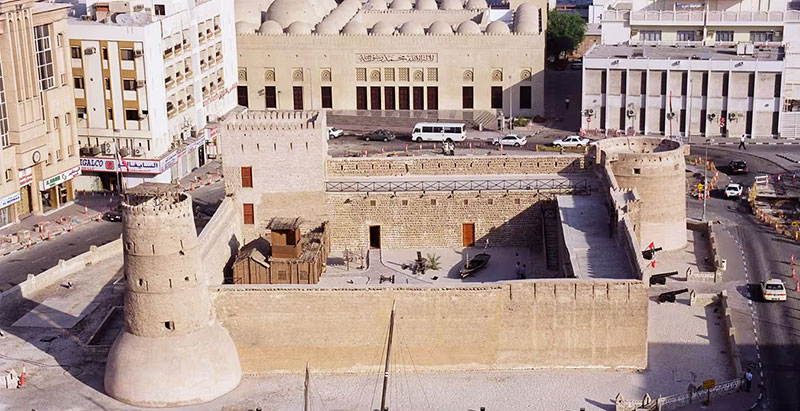
Al Fahidi Fort reflects the local architectural style that was common in the region. It was designed in the shape of a square fortress, covering an area of about 1,535 square meters. Its walls were built from sea stones coated with gypsum, while palm trunks and wood were used for the roofing of some parts.
The fort is surrounded by three defensive towers. Two of them are circular, while the third is square. These towers were used for surveillance and defense. Some of the upper areas of the fort were also used as cannon positions, which confirms its defensive role during that period.
Dubai Museum Inside Al Fahidi Fort
Al Fahidi Fort became a complete museum that presents the history of Dubai and the life of its people in the past. The visit usually begins inside the fort, where visitors can see models of old weapons and war clothing. They then move to the inner courtyard, which displays models of traditional small boats, a palm-frond house known as an arish, and a traditional barjeel, which was used to provide ventilation in old homes.
In March 1995, a new underground section was opened and added to the fort. This gave the museum more space to display historical scenes and visual experiences that tell the story of Dubai’s development over time. This section takes visitors on a journey through old markets, mosques, traditional homes, farms, oases, and desert life, before moving on to the world of the sea, pearl diving, and boat building.
Main Exhibits at Al Fahidi Fort
Dubai Museum at Al Fahidi Fort includes a wide range of exhibits that help visitors understand what life in the emirate was like in the past. Among the most notable items are copper objects, ceramics, pottery, and archaeological pieces discovered in different locations across Dubai.
Some of these items date back thousands of years. They include discoveries found in ancient graves dating back between three and four thousand years. The museum also displays artifacts from areas such as Hatta, Al Sufouh, Al Qusais, and Jumeirah, along with stone tools, bronze objects, and items connected to everyday life in the past.
Sections of Al Fahidi Fort
Al Fahidi Fort and Dubai Museum include several sections that present different aspects of the emirate’s history. The most important sections include:
Old Dubai
This section presents scenes from daily life in old Dubai, including traditional markets, mosques, and popular homes that reflected the simplicity and close social ties of the community.
Oases and Agriculture
This section offers a view of agricultural life in Dubai. It explains how crops were irrigated using the falaj system and how water was distributed across farmland.
Desert Life
The desert section focuses on the lifestyle of people who lived in the desert. It presents the Bedouin tent, traditional clothing, methods of lighting a fire, and customs linked to life in the desert environment.
The Sea and Pearl Diving
The sea has always been an important part of Dubai’s history. For this reason, the museum dedicates a section to traditional boat building, fishing tools, and pearl diving equipment. Pearl diving was a profession that remained closely connected to the life of people in the Gulf for many years.
Archaeology
This section includes a collection of archaeological pieces discovered in different areas of Dubai. Among them are burial sites dating back to the first and second centuries BC, along with ancient tools that were used in daily life.
Folk Arts
This section displays traditional musical instruments such as the drum, tambourine, flute, rababa, and manior. It also introduces visitors to different forms of heritage dances, including the traditional Al Ayyala dance.
Weapons and Old Dubai Fortifications
This section presents models of traditional old weapons, with explanations of how they were made and used. It also includes information about the fortifications that helped protect Dubai in the past.
Cultural Importance of Al Fahidi Fort
The importance of Al Fahidi Fort is not limited to being an old historical building. Its value also lies in its role in preserving local memory and introducing new generations to the roots of the city. It gives visitors the chance to learn about life before the modern urban boom and shows how Dubai developed from a community that depended on the sea, trade, and traditional crafts into a modern global city.
Dubai Culture and Arts Authority manages the site and organizes school, educational, and tourist visits. This strengthens the role of the fort as a cultural and educational center open to the public.
Al Fahidi Fort on the UAE Currency
Because of its historical value and its place in Dubai’s memory, the image of Al Fahidi Fort appeared on the front side of the UAE 100-dirham banknote. This reflects its status as a symbol of national heritage and as a landmark connected to the emirate’s history, architecture, and cultural identity.
Location of Al Fahidi Fort
Al Fahidi Fort is located in the Bur Dubai area, near the Ruler’s Court. This area is known for its historical character and its proximity to several markets and heritage sites. Its location makes it easy for visitors to include the fort as part of a cultural tour in the heart of old Dubai.