GDRFA Dubai raced against time to expand the role of technology and artificial intelligence
From long queues and time-consuming procedures to a smart crossing completed in no more than 3 seconds, Dubai has achieved a major transformation in the passenger experience across its air entry points, supported by an advanced system that brings together artificial intelligence, biometric technologies, and pre-screening of traveler data.
Rather than responding to the continued rise in arriving and departing passengers by adding more passport control counters, Dubai chose a different path. It redesigned the entire passenger journey so that most procedures are completed before the traveler reaches the crossing point.
Behind this transformation is a long development journey led by the General Directorate of Residency and Foreigners Affairs in Dubai. Over the years, the authority moved from traditional procedures based on presenting documents and manual inspection to smart systems capable of completing transactions quickly and accurately, while giving travelers a smoother and more seamless experience.
Changing the Concept of Travel
For more than two decades, GDRFA Dubai has continued to develop its systems and services to keep pace with the rapid growth in passenger traffic. However, this development did not focus on expanding reliance on traditional counters. Instead, it gradually reduced that dependence while increasing the use of artificial intelligence, smart gates, and biometric technologies.
Passenger numbers reflect the scale of the change across Dubai’s air entry points. In 2011, the number of arriving and departing travelers stood at about 28 million. By the end of 2024, the figure had exceeded 63 million, more than doubling in just 13 years.
Despite this significant growth, the increase in passenger numbers did not lead to longer queues or additional waiting time. On the contrary, the time required to complete procedures fell as the number of travelers rose, supported by the growing use of technology and smart systems.
Dubai’s experience has shown that handling record growth in passenger traffic does not necessarily require more counters. Instead, it requires a complete rethink of the passenger journey and the transfer of routine procedures to efficient digital systems operating in the background.
From Minutes to Seconds
During the early stages of development, GDRFA Dubai, in cooperation with the entities operating at air entry points, focused on upgrading the systems used by passport control officers. It also worked on developing their skills and readiness to complete passenger procedures as quickly as possible.
Reducing waiting time was among the main priorities. However, the continued growth in passenger traffic through Dubai International Airport created a new reality. It became clear that the sustainable solution was not to add more passport control counters, but to rebuild the traveler’s journey from beginning to end.
In line with the directives of His Highness Sheikh Mohammed bin Rashid Al Maktoum, Vice President and Prime Minister of the UAE and Ruler of Dubai, may God protect him, regarding the use of modern technologies to make people happier and improve their lives, a continuous journey of development and innovation began.
This journey succeeded in gradually reducing the time needed to complete procedures. The process moved from several minutes under traditional systems to less than 30 seconds, then less than 15 seconds, followed by 10 seconds, and finally just 3 seconds in the latest phase of development.
This progress represents more than faster processing. It reflects a broader change in the travel experience, allowing passengers to move through procedures smoothly without noticing the details or having to stop for long periods at inspection points.
Smart Gates: The First Step Toward Transformation
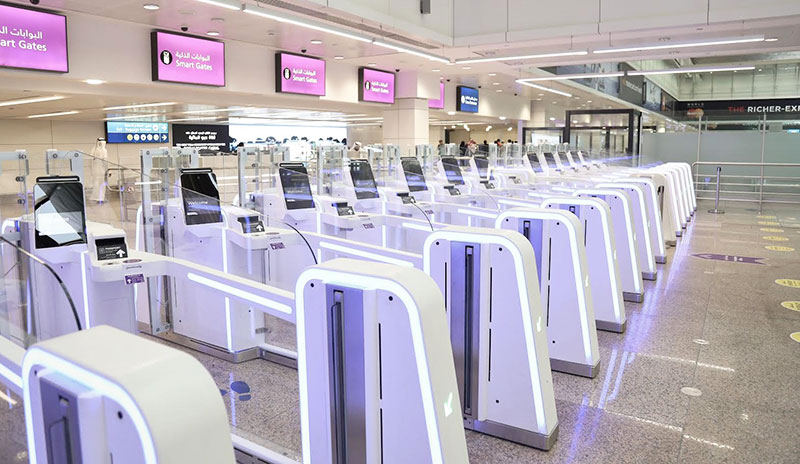
The technological transformation at GDRFA Dubai did not begin in recent years. Its earliest phase dates back to 2002, when smart gates were introduced, marking a key starting point toward a travel experience driven by technology rather than traditional procedures.
Since then, the smart gates have undergone continuous updates and improvements aimed at expanding their use, improving efficiency, and increasing their ability to handle growing passenger volumes.
By 2014, the number of people registered in the smart gate system had exceeded 1.5 million. Around 25,000 passengers were using the gates every day, out of approximately 130,000 travelers passing through Dubai airports daily at that time.
As development continued, the number of smart gate users rose to more than 33 million passengers annually, while the total number of gates reached 127 across Dubai’s air entry points.
The project’s impact was not limited to faster procedures. It also strengthened the human side of the travel experience. Dubai International Airport provided a dedicated gate in Terminal 3 for travelers of determination, helping them complete the process with greater ease and independence.
Screening Before Reaching the Crossing Point
The “Next-Generation Departure” project marked another advanced stage in Dubai’s smart transformation. It moved a large part of the verification and screening process to the period before the traveler reaches the passport control officer.
Under the traditional model, procedures began when the passenger stood in front of the officer and presented travel documents. Under the new system, traveler data is checked and screened in advance, leaving only identity matching against the information already stored in the system at the crossing point.
This approach helped reduce processing time to around 10 seconds. It also redistributed the steps of the process, moving a significant portion of the work away from passport control counters and into an integrated digital system operating in the background.
This transformation is not merely about saving time. It represents a complete change in the way the process is managed. Smart systems can now handle repetitive tasks in advance, while human teams focus on cases that require specialized intervention.
As the model continues to develop, GDRFA Dubai aims in the future to reduce around 95% of the passport control counters currently in use, which are staffed by nearly 2,000 employees. Specialized teams would remain in place to handle cases requiring human intervention and to supervise technical systems and smart gates.
The “Red Carpet”: The End of the Stop Point
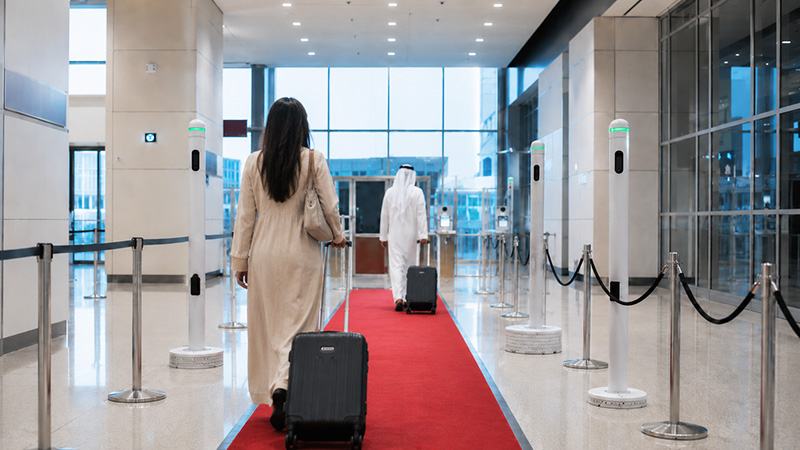
Following the success of the smart gate experience, Dubai moved to a more advanced stage designed to remove the idea of stopping at a traditional crossing point altogether. This was achieved through the smart corridor project known as the “Red Carpet.”
The project allows travel procedures to be completed while the passenger walks through the corridor, without the need to stop at a counter, present a passport, or wait for screening to be completed.
Initial testing began in 2018. The project then passed through several stages of development and improvement before its official launch in 2025.
The smart corridor has a capacity around 10 times greater than conventional smart gates. It can complete procedures for up to 10 passengers at the same time, helping accelerate passenger movement and accommodate larger numbers during peak periods.
The project relies on a range of advanced technologies, including artificial intelligence, traveler databases, machine learning, and biometric features, including iris scanning, to identify passengers and complete their procedures automatically as they move through the corridor.
GDRFA Dubai succeeded in reducing processing time through the smart corridor from 6 seconds to just 3 seconds, reflecting the authority’s continued efforts to develop and improve high-impact projects.
As a result, the crossing point is no longer a place where passengers must stop. It has become a smart path through which procedures are completed automatically and seamlessly.
Artificial Intelligence Does Not Eliminate the Human Role
Alongside the launch of smart projects, GDRFA Dubai continued to update its systems and train employees to work with modern technologies. It also prepared them to communicate with passengers arriving from different countries and cultural backgrounds.
Passport control officers across Dubai’s air entry points can now communicate in several languages, including Arabic, English, French, German, Spanish, Russian, Urdu, Persian, Portuguese, and Chinese.
This linguistic diversity improves communication with visitors, helps officers better understand their needs, and supports a travel experience suited to the wide cultural diversity seen at Dubai airports every day.
Despite the growing use of artificial intelligence and automated systems, the human element has not disappeared from operations. Instead, the nature of the employee’s role has changed. Smart systems now handle most routine procedures, while officers focus on cases requiring experience, judgment, and direct communication.
When there is suspicion surrounding a travel document, the case moves from the automated track to a specialized process, where document experts examine it and verify its authenticity.
This integration creates a balance between the speed of technology and the accuracy of human expertise, improving efficiency while maintaining high levels of security and inspection.
A More Human Travel Experience
Amid this major technological development, GDRFA Dubai has preserved the human dimension as a central part of the travel experience. The focus has not been limited to speed, but has also included the needs of different passenger groups.
Mothers traveling with children, senior citizens, and passengers who require assistance are given priority in completing their procedures, helping ensure a more comfortable and convenient experience.
Dubai has also introduced the first passport control counter designed specifically for children, turning travel procedures into a positive and memorable experience for young passengers.
The importance of this initiative is not measured only by the number of transactions completed at the counter. It is also reflected in the positive impact it leaves on children and their families, and in the welcoming image it creates from the beginning of the journey.
This integrated system has contributed to higher passenger satisfaction and the achievement of “zero complaints,” according to GDRFA Dubai statistics covering 2024 and the first four months of 2025, during which the authority handled more than 86 million passengers.
Travel in Dubai is therefore no longer based on passengers waiting for procedures to be completed. Instead, the procedures are completed before travelers even become aware of them, through a model that combines technological speed and security accuracy.