The Dubai Electricity and Water Authority continues to develop clean energy infrastructure projects through an integrated approach that places environmental protection, the preservation of natural resources, and biodiversity conservation at the heart of energy sector development.
By incorporating sustainability standards throughout different stages of its projects, DEWA continues to support Dubai’s efforts to reduce carbon emissions, improve resource efficiency, and strengthen the emirate’s position as a global model for smart and sustainable cities.
Saeed Mohammed Al Tayer, Managing Director and CEO of Dubai Electricity and Water Authority, said: “At DEWA, we draw inspiration for our efforts to protect the environment and promote sustainability from the directives of the wise leadership, which has made the United Arab Emirates a global model in climate action, sustainable development, and preserving natural resources for future generations.”
He added: “We are working to achieve the goals of the Dubai Clean Energy Strategy 2050 and the Dubai Net Zero Carbon Emissions Strategy 2050 by implementing world-class projects that support Dubai’s goal of providing 100% of its total power production capacity from clean energy sources by 2050, according to the highest standards of efficiency, reliability, and sustainability.”
He explained: “Our projects demonstrate that the development of future infrastructure is based on an integrated vision that takes into account environmental protection, resource conservation, and biodiversity enhancement, in line with the UAE’s legacy of sustainability and Dubai’s ambition to build a greener, more resilient, and prosperous future.”
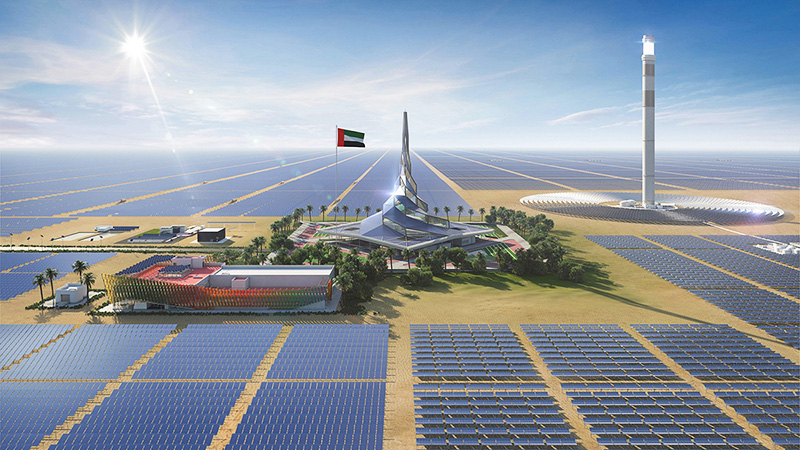
Mohammed bin Rashid Al Maktoum Solar Park
The Mohammed bin Rashid Al Maktoum Solar Park is one of Dubai Electricity and Water Authority’s most prominent clean energy projects. It is also the world’s largest single-site solar park based on the Independent Power Producer model.
The solar park represents a major pillar of Dubai’s drive to increase its reliance on clean energy sources, supporting the emirate’s long-term plans for sustainability, stronger energy security, and a lower carbon footprint.
Alongside its solar energy projects, Dubai is also developing the pumped-storage hydroelectric power plant in Hatta, the first project of its kind in the Gulf Cooperation Council countries.
The plant has a production capacity of 250 megawatts and a storage capacity of 1,500 megawatt-hours, with an expected lifespan of up to 80 years, strengthening its role in improving the efficiency and flexibility of Dubai’s energy system.
According to the Emirates News Agency, WAM, these projects collectively contribute to strengthening energy security, reducing carbon emissions, and accelerating the transition toward a low-carbon economy.
Environmental Sustainability Across All Project Stages
Dubai Electricity and Water Authority integrates environmental sustainability into every stage of project planning, design, construction, and operation, ensuring that environmental considerations are addressed from the earliest phases of each project.
Environmental impact assessments help identify potential effects associated with projects, strengthen compliance with regulatory requirements, and incorporate sustainability principles into comprehensive environmental management plans.
DEWA also carries out regular environmental monitoring programs that assess air, water, and soil quality, as well as noise levels. These programs enable the authority to take corrective measures when necessary and support continuous improvement in environmental performance.
Resource Efficiency and Waste Management
Efficient resource use and waste management are key elements of Dubai Electricity and Water Authority’s sustainability strategy, reflecting an approach focused on maximizing the value of resources while reducing the environmental impact of its projects.
Based on circular economy principles, DEWA’s projects focus on optimizing resource use, reducing waste generation, and promoting reuse, recycling, and material recovery in line with recognized environmental standards.
The authority also incorporates a range of key sustainability priorities into its institutional framework, including climate change, emissions, energy, water, waste, the circular economy, and biodiversity.
Supporting Climate Neutrality and a More Sustainable Future
The integrated approach adopted by Dubai Electricity and Water Authority highlights the close connection between expanding clean energy projects and protecting the environment and natural resources.
By continuing to invest in sustainable projects and clean technologies, the authority supports the ambitions of the UAE and Dubai to achieve climate neutrality while strengthening energy security and building a sustainable development model that benefits both current and future generations.