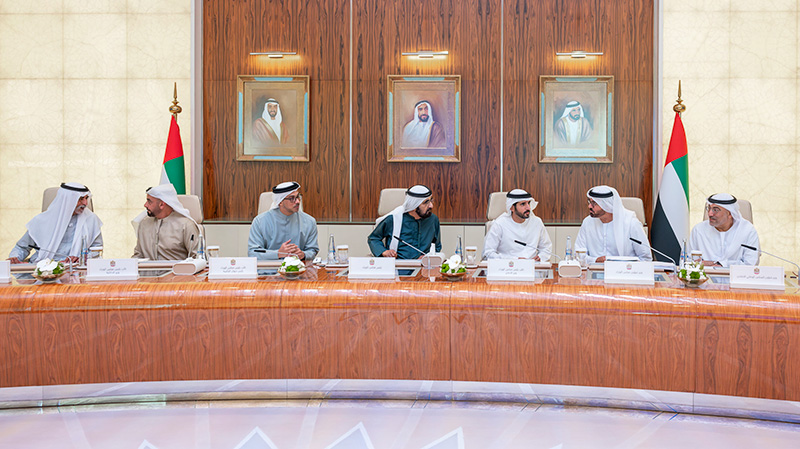
His Highness Sheikh Mohammed bin Rashid Al Maktoum, Vice President and Prime Minister of the UAE and Ruler of Dubai, may God protect him, chaired a meeting of the UAE Cabinet at Qasr Al Watan in Abu Dhabi, in the presence of His Highness Sheikh Mansour bin Zayed Al Nahyan, Vice President, Deputy Prime Minister, and Chairman of the Presidential Court.
The meeting was also attended by His Highness Sheikh Hamdan bin Mohammed bin Rashid Al Maktoum, Crown Prince of Dubai, Deputy Prime Minister, and Minister of Defense; His Highness Sheikh Maktoum bin Mohammed bin Rashid Al Maktoum, First Deputy Ruler of Dubai, Deputy Prime Minister, and Minister of Finance; and Lieutenant General His Highness Sheikh Saif bin Zayed Al Nahyan, Deputy Prime Minister and Minister of Interior.
During the meeting, the Cabinet approved and reviewed a wide range of national projects and policies reflecting the UAE’s continued efforts to advance government operations, strengthen future readiness, and accelerate the adoption of advanced technologies across key sectors.
Three Messages to Government Teams
At the start of the new government season, His Highness Sheikh Mohammed bin Rashid Al Maktoum, may God protect him, delivered three key messages to government teams.
His Highness Sheikh Mohammed bin Rashid Al Maktoum, may God protect him, said: “Today, I chaired a Cabinet meeting at Qasr Al Watan in Abu Dhabi… As we begin our new government season, we have three messages for our team:
Our first message: We do not wait for ideal circumstances to continue our achievements… Our projects are continuing, our economy is growing, our markets are operating at full capacity… and our events are welcoming the world… The UAE does not stop… and will not stop.”
His Highness added: “Our second message: We have begun work on the largest transformational project for government services through agentic artificial intelligence… Our project is strategic, national, and future-focused, and we are counting on it to create a major qualitative shift in government… Our message to all work teams is to be part of this strategic transformation of the UAE Government.”
His Highness continued: “Our third message: The trust that the UAE has built over decades is the currency we are counting on… Trust built through the development of legislation, systems, and policies, through massive resources invested in the best infrastructure in the world… and through a reputation that has been established and international relationships that have been built.”
These messages reflect the UAE Government’s direction toward maintaining the pace of achievement while expanding the use of future technologies and preserving the trust that has helped establish the country’s strong regional and international standing.
Launching the AI Adviser for the UAE Cabinet
The UAE Cabinet approved the launch and implementation of the “AI Adviser for the UAE Cabinet,” a new step aimed at advancing government decision-making, accelerating the review of policies, projects, and initiatives, and improving the quality of government outcomes.
His Highness Sheikh Mohammed bin Rashid Al Maktoum, may God protect him, said: “During today’s Cabinet session, we also approved the launch and implementation of the ‘AI Adviser for the UAE Cabinet’… a new step in advancing government decision-making…
and accelerating the study of policies, projects, and initiatives… and improving the quality of government outcomes… The system operates through 32 AI assistants specialized in analyzing policies, legislation, strategies, and systems, assessing their impacts, reviewing global best practices, and providing recommendations… The system will work with ministers 24 hours a day to follow up on decisions and their implementation.”
The system forms part of the UAE Government’s broader efforts to expand the use of agentic artificial intelligence across government operations and build a more flexible and efficient system capable of using data to support decision-making.
The AI Adviser for the UAE Cabinet relies on 32 specialized AI assistants that assess the financial, economic, social, and environmental impacts of matters presented to the Cabinet, compare them with global best practices, take national priorities into consideration, and provide recommendations based on approved sources and inputs.
The system also takes into account the confidentiality of matters submitted to the Cabinet and complies with cybersecurity standards adopted in the UAE.
The Cabinet also approved a system for issuing its decisions within a governance framework supported by agentic AI technologies, with the aim of strengthening continuity in government operations and accelerating the decision-making process.
Training 22,000 Teachers in Artificial Intelligence Tools
In the education sector, the UAE Cabinet reviewed a program to develop the capabilities of teachers and education professionals using artificial intelligence tools.
His Highness Sheikh Mohammed bin Rashid Al Maktoum, may God protect him, said: “Today, at the Cabinet, we also reviewed a program to develop the capabilities of teachers and educators using artificial intelligence tools…
The goal is to train 22,000 teachers and educators to use agentic artificial intelligence in teaching, assessment, curriculum analysis, lesson planning, and enhancing the spirit of innovation among students… Major technological transformations will change the reality, processes, and tools of education… and for teachers to perform their new role, they must also become lifelong learners…
because if we teach our children today the way we taught them yesterday, we deprive them of tomorrow… The UAE is one of the first countries in the world to develop comprehensive curricula for teaching artificial intelligence to students across all educational stages… Today, we also approved a mechanism to make this curriculum available to ministries of education in countries around the world so everyone can benefit from the UAE experience.”
The Cabinet approved the rollout of the artificial intelligence curriculum across all public and private schools in the country after it was tested and its results were evaluated in public schools.
The curriculum aims to equip students with the skills and knowledge needed to understand artificial intelligence and its applications, including data and algorithms, while also strengthening awareness of responsible use and the risks associated with these technologies.
The curriculum is also supported by a program to build the capabilities of more than 22,000 teachers, providing education professionals with the tools and training needed to keep pace with rapid developments in the field.
The Cabinet also approved a mechanism that will allow the curriculum and its components to be shared with the international education community, expanding global access to the UAE’s experience in artificial intelligence education.
UAE Government Annual Meetings in November
The UAE Cabinet approved the agenda for the UAE Government Annual Meetings, which will be held from November 8 to 10.
His Highness Sheikh Mohammed bin Rashid Al Maktoum, may God protect him, said: “Today, we approved the agenda for the UAE Government Annual Meetings, which will be held from November 8 to 10… the national platform where we review what has been achieved… and shape the next phase of our government journey… This year’s edition is titled ‘Readiness and Resilience’… readiness in our economy… in our supplies and logistics services… in our resources…
and in our families… We will also review the progress made by government entities in employing agentic artificial intelligence in their work and services… and we will celebrate the winners of the first edition of the ‘UAE Years Award’… We invite everyone to participate with their stories… The UAE today is stronger because of its teams and the determination of its people… and our ambition knows no limits, God willing.”
The annual meetings serve as a national platform for reviewing progress on government objectives, discussing upcoming priorities, and strengthening coordination among different entities.
Regulating Autonomous Vehicles in the UAE
As part of efforts to support future sectors and regulate emerging technologies, the UAE Cabinet approved a decision concerning the regulation of autonomous vehicles in the country.
The decision establishes mechanisms and requirements for the inspection, registration, licensing, and renewal of autonomous vehicles, as well as rules governing the testing of new vehicle technologies.
It also regulates the responsibilities of relevant parties, including agents, operators, and passengers, while defining the responsibilities of authorities involved in licensing and regulating autonomous vehicles at both the federal and local government levels.
The new framework is expected to support innovation in the transport sector, encourage the adoption of more sustainable and environmentally friendly technologies, contribute to reducing congestion and pollution, and strengthen road safety.
Supporting Balanced Development and Local Communities
The UAE Cabinet reviewed the 2025 report of the Emirates Council for Balanced Development, chaired by His Highness Sheikh Theyab bin Mohamed bin Zayed Al Nahyan, Deputy Chairman of the Presidential Court for Development and Fallen Heroes’ Affairs.
The Council works to promote balanced development by supporting family cohesion, community participation, and well-being, while helping build diverse small-scale local economies through support for farmers, craftspeople, entrepreneurs, and small and medium-sized enterprises.
It also focuses on preserving local heritage and traditional crafts, strengthening cultural identity, and developing tourism destinations that showcase the UAE’s geographic, environmental, and cultural diversity.
Projects developed by the Council included farm trails and Qidfa Corniche, restoration of Falaj Al Wurai, the establishment of Masfout Gate, and development work on Al Dhayah Majlis and Eco Trail, as well as the boulevard and corniche in Al Rams.
The Council also completed waterfront development projects and upgraded tourism facilities in Al Sila, while organizing a range of cultural, sports, and entertainment festivals and events across different areas of the UAE.
The events and facilities developed by the Council attracted more than 350,000 visitors, with participation from more than 5,000 people across various programs.
More than 57 small and medium-sized enterprises also participated, along with 84 productive families and farmers and more than 350 volunteers, helping support sustainable income opportunities and strengthen community participation in economic activities.
The UAE Strengthens Its Position as a Global Capital for Entrepreneurship
The UAE Cabinet reviewed updates on initiatives under the national campaign “The UAE: The Capital of Entrepreneurs in the World,” which aims to further establish the country as a leading global destination for entrepreneurship and expand opportunities available to Emirati youth.
Small and medium-sized enterprises and startups play a central role in the national economy, accounting for more than 95% of all companies in the country and contributing more than 63% of non-oil GDP.
Initiatives under the campaign included the launch of a national platform for entrepreneurs through the New Economy Academy, as well as the “Emirati Tax Agent” program, which aims to qualify 500 UAE nationals.
The campaign also includes foundational and advanced training programs for 10,000 UAE nationals.
Other initiatives include organizing the Young Merchant Exhibition in a number of schools, an entrepreneurship exhibition for university graduates, and incubating 50 real estate startups, with participation from federal and local government entities and private-sector institutions.
Emirates Skills Platform Looks Ahead to the Jobs of the Future
The Cabinet also reviewed updates on the Emirates Skills Platform, which was developed as a national platform for anticipating future skills needs and preparing human capital for the jobs of tomorrow.
The platform is powered by an artificial intelligence-supported national system designed to help government entities, educational institutions, and individuals align education outcomes with labor market needs and strengthen data-driven planning.
More than 8,300 users benefited from the platform during its pilot phase, including government institutions, university and school students, administrative and academic staff, and parents.
The platform offers tools for real-time labor market analysis, predictive modeling of future jobs and skills, personalized career guidance, and support for evidence-based policy design, helping educational institutions and individuals make more accurate and better-aligned decisions.
Launching Early Childhood Week in November 2026
As part of national programs under the Year of the Family, the UAE Cabinet approved the launch of the first nationwide edition of Early Childhood Week across all Emirates from November 16 to 22, 2026.
The initiative aims to support children during the earliest years of life and strengthen the role of the family as a core pillar of a cohesive society by turning public spaces into interactive environments for learning and play.
The week will also provide parents and caregivers with practical opportunities to strengthen their connection with children through community events and experiences involving the social, health, education, and sports sectors.
A New National Policy for Eco-Tourism
The UAE Cabinet also approved the National Eco-Tourism Policy as part of the country’s efforts to balance economic development with the protection of ecosystems and natural resources.
His Highness Sheikh Mohammed bin Rashid Al Maktoum said: “During the meeting, we approved the National Eco-Tourism Policy… and we also reviewed the results of implementing the National Strategy to Combat Desertification 2022–2030…
which has achieved tangible progress in protecting ecosystems and sustaining natural resources, with the number of nature reserves increasing to 55… 4,900 hectares of land rehabilitated… more than 3.2 million square meters of green spaces added… and 341,000 local trees numbered and protected.”
His Highness added: “Protecting our environment is a national responsibility… and investing in our natural resources is an investment in quality of life.”
The National Eco-Tourism Policy aims to regulate and develop the sector sustainably, protect natural sites, and expand tourism products, services, and experiences that reflect the UAE’s environmental and cultural assets.
The policy also focuses on expanding community participation in eco-tourism, raising awareness of responsible tourism practices, and supporting cooperation among government entities, the private sector, and civil society.
Its initiatives include the establishment of a smart platform for eco-tourism, the development of partnership networks, and new regulations for managing and organizing eco-tourism sites.
55 Nature Reserves and More Than 380,000 Trees
The UAE Cabinet also reviewed the results of implementing the National Strategy to Combat Desertification 2030, which has achieved measurable progress in protecting ecosystems and strengthening the sustainability of natural resources.
The number of nature reserves in the UAE has increased to 55, while approximately 4,900 hectares of land have been rehabilitated and more than 380,000 trees planted.
More than 3.2 million square meters of green spaces and ground cover have also been added, while 341,000 local trees have been numbered and protected.
In addition, more than 120 local plant genetic resources have been monitored and identified.
These results highlight the continued expansion of national efforts in afforestation, land rehabilitation, biodiversity protection, and the sustainable management of natural resources, supporting both environmental resilience and quality of life.
The UAE Moves Confidently Toward the Future
The decisions and initiatives reviewed during the Cabinet meeting demonstrate the UAE’s continued ability to advance on multiple fronts at the same time — from developing government decision-making through artificial intelligence and preparing students and teachers for the future, to regulating autonomous vehicles, supporting entrepreneurship and local development, and protecting natural resources through eco-tourism and environmental initiatives.
The direction of the next phase was summed up clearly in the words of His Highness Sheikh Mohammed bin Rashid Al Maktoum, may God protect him: “The UAE does not stop… and will not stop,” reaffirming the country’s commitment to continuous progress, faster development, and sustained investment in people, technology, the economy, and the environment within an integrated national vision.