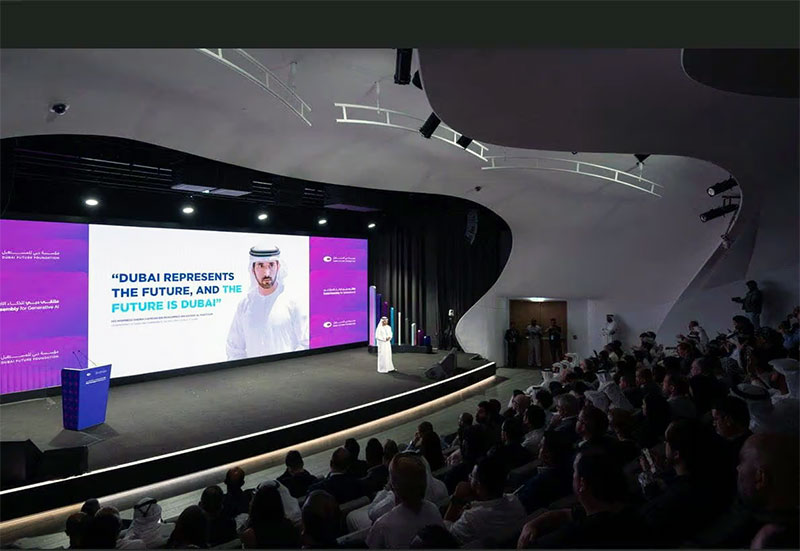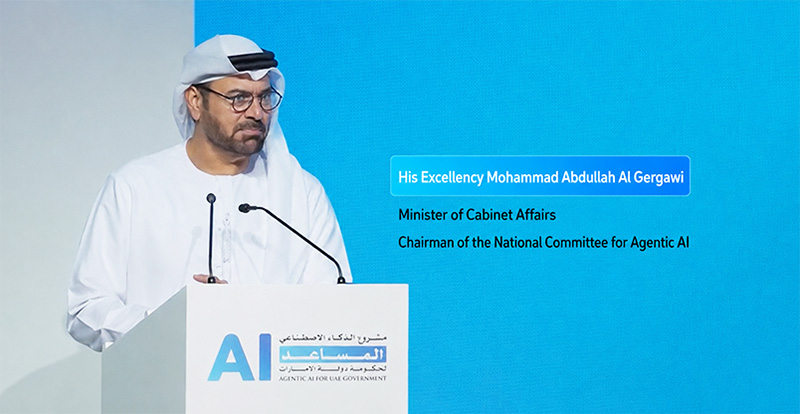
His Excellency Mohammad Abdullah Al Gergawi, Minister of Cabinet Affairs and Chairman of the National Committee for AI Assistant, affirmed that building national capabilities and equipping government talent with artificial intelligence skills and tools are key pillars of the UAE Government’s efforts to develop a more efficient and future-ready government model.
The announcement comes with the launch of the first cohort of the “Train-the-Trainer Program” under the AI Assistant Project, as part of the capacity-building and training track. The program aims to establish a network of 1,000 trainers from national talent across federal ministries and government entities, enabling them to lead knowledge transfer efforts and support the adoption of AI Assistant applications across government workplaces.
Training 1,000 Emirati Trainers From 50 Federal Entities
His Excellency Mohammad Al Gergawi said: “Government transformation through artificial intelligence does not begin with technology alone, but with people capable of using it and creating real value through it. Through the program, we aim to train 1,000 Emirati trainers from 50 federal entities to lead the most important transformational project in AI Assistant applications at the federal level, to lead this transformation, transfer knowledge to work teams, and deploy AI Assistant in the way government works, in decision-making, and in the development of services and operations.”
His Excellency added: “Developing the capabilities of 1,000 trainers in government represents an investment in the sustainability of transformation and the establishment of a national network of talent capable of multiplying the impact of knowledge and accelerating the adoption of AI Assistant applications across various sectors. We want government entities to have the capabilities and expertise that enable them to lead their own transformation, develop their solutions, and create more efficient and effective operating models.”
The program reflects a broader direction toward embedding expertise within government entities themselves, allowing work teams to make practical use of AI Assistant technologies and turn knowledge into solutions that can be applied to services, operations, and decision-making.
250 Participants in the First Cohort
The Federal Authority for Government Human Resources organized an extensive workshop for participants in the first cohort of the program, which includes 250 participants from 50 federal ministries and government entities representing 12 vital sectors.
The workshop aimed to introduce participants to their roles and responsibilities as trainers, while also reviewing the main pillars of the capacity-building program and presenting the workstreams of the National Committee for AI Assistant.
The launch also featured introductory presentations on the responsibilities of the National Committee for AI Assistant, the project’s operating model and various tracks, as well as technical and practical workshops delivered in cooperation with strategic knowledge partners.
Building Government Capabilities to Lead Change
Her Excellency Ohood bint Khalfan Al Roumi, Minister of State for Government Development and the Future and Chairwoman of the Federal Authority for Government Human Resources, affirmed that the Train-the-Trainer Program represents a major pillar within the capacity-building and training track of the government’s AI Assistant Project. It aims to qualify government talent capable of leading knowledge transfer, developing the skills of work teams, and supporting federal entities in integrating AI Assistant into their work, operations, and services.
Her Excellency Ohood Al Roumi said: “Each trainer will become a starting point for building new capabilities within their entity, as the success of transformation through artificial intelligence depends on our ability to turn knowledge into practice, and practice into solutions and applications that deliver a tangible impact on government efficiency and the quality of services.”
Her Excellency added: “The program establishes a base of government talent that combines technical knowledge with the ability to train and manage change, enabling entities to build their capabilities independently and accelerating the development of use cases and practical AI Assistant applications in line with the needs and priorities of each entity.”
This approach represents an important step toward building sustainable government capabilities that can keep pace with rapid technological developments and make effective use of artificial intelligence to improve working methods and service quality.
A Three-Month Training Program
The 1,000 participants have been divided into four cohorts, each comprising 250 participants. They will take part in a three-month training program totaling 60 training hours.
The first cohort includes participants from 50 federal ministries and government entities representing 12 vital sectors, including education, security and justice, health and society, foreign affairs, finance and economy, media and culture, energy, technology, human resources, and the environment.
The broad sector representation is designed to expand the program’s impact and support the transfer of expertise across government, while helping entities develop use cases and applications suited to the nature of their work.
Three Main Pillars of the Program
The Train-the-Trainer Program focuses on three main areas: technical skills, training skills, and practical projects and applications within government entities.
The program covers several topics, including working with artificial intelligence, the governance and design of AI Assistant systems, the development of use cases, and the design and development of AI Assistant agents. It also includes training skills and change management.
This content enables participants to combine technical knowledge with practical capabilities, strengthening their ability to train work teams and support government entities in developing applicable solutions based on their specific priorities and needs.
Partnerships With Technology and Academic Institutions
The Federal Authority for Government Human Resources oversees the implementation of the Train-the-Trainer Program in cooperation with a group of strategic knowledge partners from national and international technology companies and institutions.
The partners include Microsoft, Inception, Mohamed bin Zayed University of Artificial Intelligence, Apolitical, the Society for Human Resource Management, and Presight.
These partnerships provide participants with diverse expertise spanning advanced technology, training, and change management, supporting the program’s goal of developing a national network capable of leading transformation across government entities.
AI Assistant as a Pillar of UAE Government 4.0
The AI Assistant Project is one of the key pillars of the UAE Government 4.0 journey, which aims to achieve a qualitative transformation in the government operating model by integrating AI Assistant across government sectors, operations, and services.
The project operates through five main tracks: operations and institutional support, strategic government work, government services, AI technologies and data, and capacity building and training.
The overall target is to transform 50% of government sectors, operations, and services into models powered by AI Assistant within two years, supporting greater efficiency and stronger future readiness across government institutions.
Training 80,000 Government Employees
Capacity building and training is one of the main tracks of the AI Assistant Project and aims to train 80,000 federal government employees to become experts in deploying AI Assistant.
The track is designed to support the sustainability of government transformation and expand the use of AI applications across different areas of government work by equipping employees with the tools and skills required to apply them effectively.