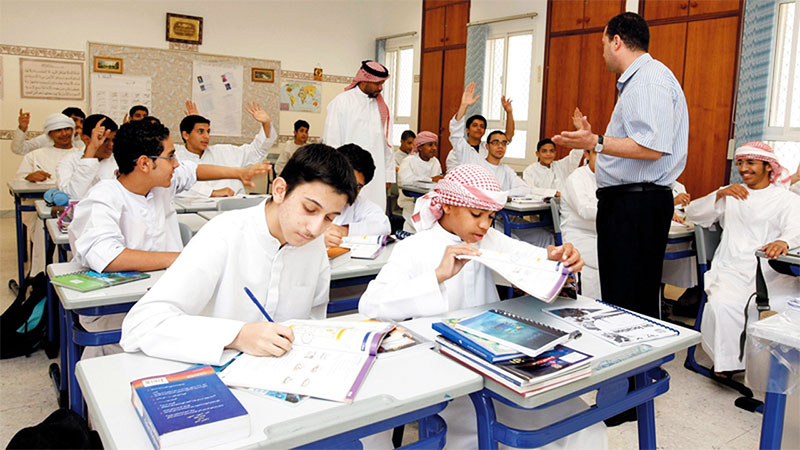
The United Arab Emirates achieved a major educational leap in the results of the Programme for International Student Assessment, “PISA 2025,” supervised by the Organisation for Economic Co-operation and Development (OECD), after students across the country recorded notable progress in science, mathematics, and reading. The UAE also ranked first among participating Arab countries in all three fields.
At the emirate level, Dubai took the lead, posting advanced results that exceeded both the national average and the OECD average in science, mathematics, and reading. The performance reflects the advanced level reached by Dubai’s education system and the continuing efforts to enhance educational quality and student skills.
Dubai students scored 506 points in science, 496 points in mathematics, and 484 points in reading.
These results placed Dubai above the UAE national average by 48 points in science, 43 points in mathematics, and 51 points in reading.
Dubai students also outperformed the OECD average by 24 points in science, 33 points in mathematics, and 23 points in reading, highlighting the progress achieved by schools across the emirate and their ability to build students’ skills in the core areas assessed by the international program.
UAE Leads Arab Countries in PISA 2025
The UAE ranked first among Arab countries participating in PISA 2025 in science, mathematics, and reading, while also recording clear improvement compared with its results in the 2022 assessment cycle.
The average performance of UAE students in science increased by 26 points to reach 458 points. Mathematics performance rose by 21 points to 453 points, while the reading score improved by 15 points to 433 points.
The scale of this progress is particularly significant in light of the broader decline in international performance. The UAE was among only eight countries and economies out of 91 participants that succeeded in improving their results across all three fields.
The UAE’s achievement becomes even more notable when compared with the average performance of OECD countries, which recorded declines in the same areas while the UAE succeeded in making balanced progress in science, mathematics, and reading.
The improvement was also reflected across different levels of student performance, with the proportion of low-performing students declining while the percentage of students reaching advanced performance levels increased. This points to broad and balanced progress in student outcomes.
Sarah Al Amiri: The Achievement Is the Result of an Integrated Education System
Minister of Education Sarah bint Yousif Al Amiri confirmed that this achievement is the result of the efforts and collaboration of all educational institutions in the country, as well as our cadres and teachers in developing students’ capabilities in reading, science, and mathematics and equipping them with the knowledge and capabilities that enable them to keep pace with future changes and contribute to shaping it. She noted that the ambition of our students and their determination to compete and excel through their capabilities and skills are an essential part of this global achievement.
She explained that these results embody a pioneering national vision in artificial intelligence and digital education and reflect the progress achieved in the digital readiness of schools and in establishing a culture of conscious and responsible use of technology and artificial intelligence. The UAE was among the first to introduce artificial intelligence as a school subject, she said, stressing the continued development of education as a fundamental pillar of comprehensive and sustainable development.
The strong performance reflects the scale of national efforts made in the education sector in recent years, whether through curriculum development and teaching methods, empowering education professionals, updating assessment policies, or making greater use of data to support educational decision-making.
Artificial Intelligence Strengthens the Digital Readiness of UAE Schools
The PISA 2025 results revealed an advanced level of digital readiness in UAE schools, alongside a growing culture of conscious and responsible use of technology and artificial intelligence within the educational environment.
A total of 81.7% of students reported that they learn in their classes how to evaluate information generated by artificial intelligence, compared with an OECD average of 62.6%.
In addition, 96.3% of students attend schools that have subject-specific guidelines governing the use of digital devices, compared with an OECD average of 71.2%.
These indicators reflect the UAE’s broader direction toward building a knowledge- and innovation-based society and economy, alongside the Ministry of Education’s initiative to incorporate artificial intelligence into school curricula and help students understand its technologies and use them responsibly.
The approach is also linked to strengthening students’ critical-thinking skills and enabling them to assess the reliability of information and digital content, skills that have become increasingly important amid the rapid expansion of artificial intelligence tools.
Dubai Offers an Educational Model That Can Be Studied and Replicated
Across the UAE, Dubai recorded the highest performance in all three fields, with students achieving 506 points in science, 496 points in mathematics, and 484 points in reading.
The results placed Dubai well above the national average and also took students in the emirate beyond the OECD average across science, mathematics, and reading, underscoring the advanced level reached by Dubai schools.
This performance provides an opportunity to study the effective educational practices that contributed to these results and to benefit from them on a wider scale, supporting efforts to raise educational performance and reduce gaps among schools and students across the country.
Dubai’s results also reflect the impact of continued investment in educational quality, teacher and school leadership development, modern learning environments, and the effective use of technology to support the educational process.
Improvement Extends Across Different Student Performance Levels
Progress in PISA 2025 was not limited to higher average scores. It also extended across different student performance levels, with the proportion of low-performing students declining at the same time as the share of students reaching advanced levels increased.
This improvement indicates the national education system’s ability to achieve broader and more inclusive progress and reach a wider range of students at a time when education systems around the world are facing growing challenges.
The UAE’s leading position among Arab countries reflects the impact of an integrated set of education policies, including curriculum development, improving teaching quality, empowering teachers, updating the national assessment system, and using the results of international assessments to improve educational policies and practices.
Cooperation among education authorities, schools, educational leaders, teachers, students, and parents has also contributed to strengthening a culture of continuous improvement and creating a more effective partnership between schools, families, and the wider community.
The results further reflect the impact of continuously updating curricula and aligning them with future skills and international best practices, alongside investment in the professional development of teachers and school leaders.
More Than 34,000 Students Took Part in the Assessment
A total of 34,639 male and female students from 1,070 schools across the UAE participated in PISA 2025, reflecting the broad scale of participation and the integration of different components of the country’s education system.
The Programme for International Student Assessment, or PISA, is one of the world’s leading international education studies. It measures the ability of 15-year-old students to apply their knowledge and skills in reading, mathematics, and science when dealing with real-world situations and changing challenges.