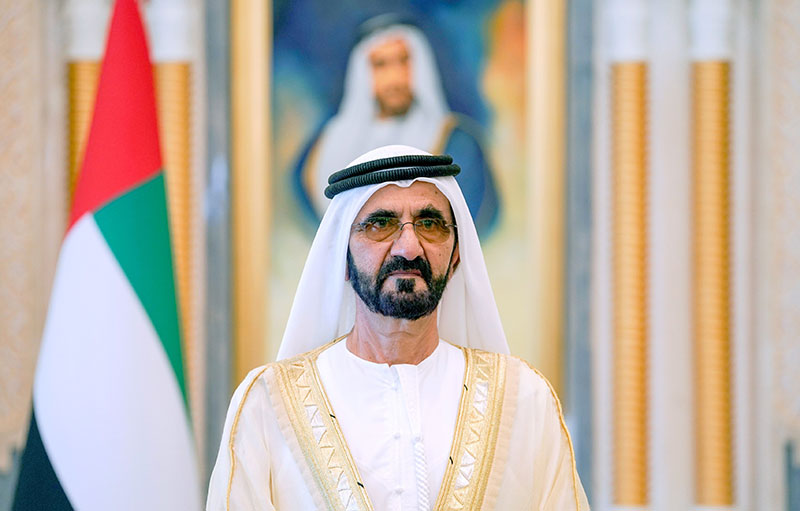
His Highness Sheikh Mohammed bin Rashid Al Maktoum, Vice President and Prime Minister of the UAE and Ruler of Dubai, may God protect him, announced that the UAE’s non-oil foreign trade came close to AED 2 trillion for the first time during the first half of 2026, recording historic results that reflect the strength and continued growth of the national economy.
His Highness Sheikh Mohammed bin Rashid Al Maktoum said: “Our non-oil foreign trade came close to the AED 2 trillion mark for the first time in just six months, reaching AED 1.937 trillion, with annual growth of 13.1%… while our non-oil exports achieved a new record of AED 452.8 billion.”
His Highness added: “These figures are not merely trade data… They reflect the strength of our economy… the effectiveness of our development choices… and the world’s confidence in the UAE.”
In a post shared on his account on the X platform, His Highness said: “Today, we reviewed the results of the UAE’s non-oil foreign trade for the first half of 2026…
The results are historic, thanks be to God. Our non-oil foreign trade came close to the AED 2 trillion mark for the first time in just six months, reaching AED 1.937 trillion, with annual growth of 13.1%…
Meanwhile, our non-oil exports achieved a new record of AED 452.8 billion. These figures are not merely trade data… They reflect the strength of our economy… the effectiveness of our development choices… and the world’s confidence in the UAE.”
Historic Performance in Non-Oil Foreign Trade
The UAE’s non-oil foreign trade reached approximately AED 1.937 trillion during the first six months of 2026, representing growth of 13.1% compared with the same period in 2025.
The value of trade also increased by 39.6% compared with the first half of 2024 and by 54.5% compared with the same period in 2023. Growth reached 78.8% compared with the first half of 2022.
These results point to the continued upward trajectory of the UAE’s trade over recent years, supported by expanding international economic relations and increased activity across exports, imports, and re-exports.
The value of non-oil foreign trade during the first half of this year was also more than double the levels recorded during the same period in 2019 and 2021, reflecting the accelerating growth of the national economy and the widening scope of its commercial activity.
Non-Oil Exports Reach a Record Level
Non-oil exports were among the main drivers of the UAE’s trade performance during the first half of 2026, reaching a record AED 452.8 billion.
Non-oil exports grew by 23.9% compared with the same period in 2025 and rose by 77.3% compared with the first half of 2024.
Their share of the UAE’s total non-oil foreign trade increased to 23.4% in the first half of 2026, compared with 21.3% during the same period in 2025.
The share of non-oil exports stood at 18.4% in 2024, compared with 16.9% in 2023, indicating a gradual shift toward an economy that relies more heavily on domestic production, exports, and value-added sectors.
China Remains the UAE’s Largest Trading Partner
China maintained its position as the UAE’s leading trading partner, with non-oil trade between the two countries reaching AED 180.7 billion during the first half of 2026.
Switzerland ranked second, with trade valued at AED 138.4 billion, followed by India at AED 107.5 billion.
Trade with several other major partners also recorded strong growth, including the Arab Republic of Egypt, the Sultanate of Oman, Hong Kong, China, and Switzerland.
The UAE’s non-oil foreign trade with its ten largest trading partners grew by 12.6% during the first half of the year, while trade with the rest of the world increased by 13.6%.
This growth highlights the breadth of the UAE’s international trade network and the diversity of the markets it serves, while also demonstrating the country’s growing role in global commerce.
Comprehensive Economic Partnership Agreements
Data from the first half of 2026 reflected the growing role of Comprehensive Economic Partnership Agreements in supporting trade and investment and opening new markets for UAE exports.
The UAE’s non-oil trade with countries whose Comprehensive Economic Partnership Agreements had entered into force reached AED 304.3 billion during the first six months of the year.
Imports from those countries totaled AED 193.5 billion, recording growth of 15.5%, while UAE non-oil exports to the same markets reached AED 66.1 billion during the period.
Non-oil exports now account for 21.7% of the UAE’s total trade with countries covered by Comprehensive Economic Partnership Agreements that have entered into force, compared with 19.1% in 2022.
This increase reflects the expanding opportunities available to UAE products in international markets and the benefits provided by these agreements in improving market access, reducing barriers, and supporting investment flows.
Gold Leads Traded Commodities
Gold continued to lead the list of major commodities traded as part of the UAE’s non-oil trade, reaching AED 706.2 billion during the first half of 2026, an increase of 48.8%.
The telecommunications device sector followed, with trade valued at AED 189.7 billion, followed by gold jewelry, automobiles, and diamonds.
The ten leading commodities accounted for around 67% of the UAE’s total non-oil merchandise trade during the first half of the year.
These results reflect the continued momentum of the UAE economy, supported by economic diversification, trade openness, expanding international partnerships, and advanced infrastructure that facilitates trade and logistics.
Al Zeyoudi: Historic Results Reflect the Success of the Leadership’s Vision
His Excellency Dr. Thani bin Ahmed Al Zeyoudi, Minister of Foreign Trade, affirmed that the historic results achieved by the UAE’s non-oil foreign trade during the first half of 2026 reflect the success of the forward-looking vision of the wise leadership, which placed the development of a diversified, competitive, and globally open economy at the heart of its priorities.
He said this vision had also enabled the national economy to keep pace with international economic transformations and turn them into opportunities for growth and prosperity.
His Excellency said that the UAE’s non-oil foreign trade approaching AED 2 trillion in just six months, at AED 1.937 trillion, represents a new historic milestone in the country’s economic journey.
He explained that these results reflect the position the UAE has reached as a global center for trade, investment, and logistics. They also demonstrate the world’s growing confidence in the UAE economy and its ability to achieve sustainable growth despite fluctuations in international markets.
Al Zeyoudi noted that the results reflect the strength and resilience of the UAE economy and its ability to continue growing under different global economic conditions, supported by the vision of the wise leadership and its approach of economic openness and stronger international trade partnerships.
He said the significance of the results lies not only in the growth of non-oil trade, but also in the sustainability of that growth and the breadth of its base across numerous markets, partners, and commodities.
This, he added, strengthens the resilience of the national economy and its ability to adapt to global changes.
He also said that coming close to AED 2 trillion during the first half of 2026 confirms that the UAE does not merely keep pace with global economic changes, but actively benefits from them to create new opportunities for growth and expansion.
His Excellency explained that the importance of the results is not limited to the overall volume of trade, but also extends to the nature and sources of growth, particularly as non-oil exports reached a historic AED 452.8 billion, representing growth of 23.9% compared with the same period last year.
He noted that the continued rise in the contribution of non-oil exports to the UAE’s total non-oil foreign trade, reaching 23.4%, is a highly significant indicator of the success of the economic diversification strategy adopted by the UAE over the past several years.
It also confirms that the national economy continues to move toward a more productive model that relies increasingly on innovation, knowledge, industry, technology, and added value.
He said the latest results also confirm that the UAE is making steady progress toward achieving the remaining foreign trade objectives of the “We the UAE 2031” vision.
He added that maintaining the current growth rates would strengthen the country’s ability to surpass a number of those targets ahead of schedule, reflecting the success of its economic policies and long-term development vision.
Partnership Agreements Drive Trade Growth
His Excellency Dr. Thani bin Ahmed Al Zeyoudi affirmed that the Comprehensive Economic Partnership Agreement program has become one of the UAE’s most important strategic drivers of trade growth.
The program has helped broaden the access of UAE exports to international markets and opened new areas for economic and investment cooperation.
He said the figures recorded during the first half of 2026 demonstrate the direct impact of these agreements, with non-oil trade involving countries whose Comprehensive Economic Partnership Agreements had entered into force exceeding AED 304 billion.
Non-oil exports to those markets reached AED 66.1 billion, indicating the success of the UAE’s approach to building a network of economic partnerships that support trade and investment flows and provide additional opportunities for the national business community.
His Excellency added that the UAE’s foreign trade performance is distinguished by the strength of its growth, its diversity, and its broad geographic reach.
The country has continued to strengthen relations with its major partners while also recording strong growth rates in new and promising markets.
His Excellency stressed that these results send a clear message to investors and trading partners around the world: the UAE continues to consolidate its position as one of the world’s most competitive and open economies, with a strong ability to attract businesses and investments.
It also continues to strengthen its role as a global platform connecting markets and economies across continents, supported by world-class infrastructure, an advanced regulatory framework, and a broad network of international partnerships.
His Excellency said these achievements provide further motivation to build on the progress already made, adding:
“We will continue working, under the directives of our wise leadership, and in close cooperation with federal and local teams and our partners in the private sector, to enhance the competitiveness of the UAE’s foreign trade, expand its network of economic partnerships around the world, support the growth of national exports, and consolidate the country’s position as a global center for trade and investment, ensuring the continuation of our economic and development achievements and the fulfillment of our national ambitions in the decades ahead.”
Abdullah Al Hamed: The UAE Has Turned Challenges Into Achievements
His Excellency Abdullah bin Mohammed bin Butti Al Hamed, Chairman of the National Media Authority, affirmed that the UAE continues its economic journey with confidence and determination, supported by a clear vision, advanced infrastructure, and a business environment capable of responding to change.
His Excellency said on X: “Not every storm disrupts the journey. Some nations turn challenges into fuel for achievement. This is the UAE: its ship continues to cut through the waves with confidence, never stopping because of a storm and never changing course because of fierce winds.”
He added: “While geopolitical developments cast their shadow over the region in recent months, the UAE continued its economic journey with confidence and determination, because it built its progress on the vision of a wise leadership that anticipates the future, world-class infrastructure, flexible legislation, and a business environment that creates certainty at a time when doubt dominates markets.”
The UAE’s non-oil foreign trade results for the first half of 2026 confirm the national economy’s ability to turn regional and international challenges into opportunities for growth, supported by the country’s strategic location, logistics infrastructure, and broad network of international economic relations.