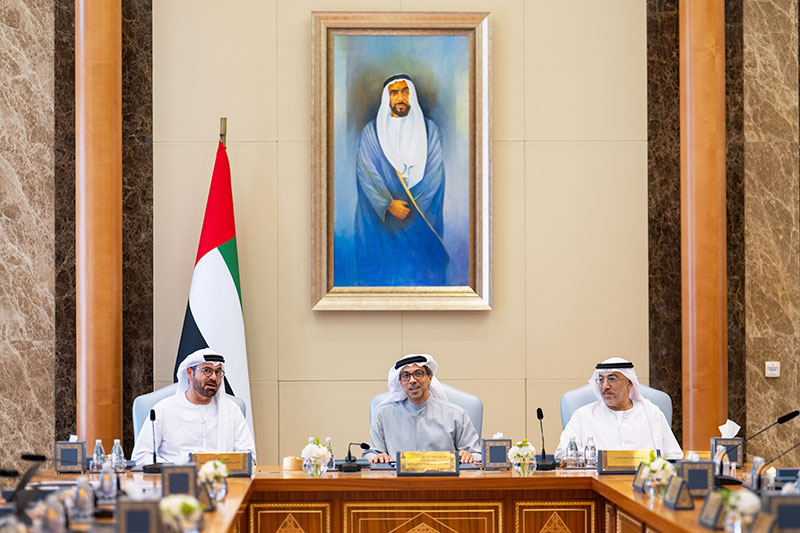
His Highness Sheikh Mansour bin Zayed Al Nahyan, Vice President, Deputy Prime Minister and Chairman of the Presidential Court, chaired a meeting of the Ministerial Council for Artificial Intelligence and Development at Qasr Al Watan in Abu Dhabi. During the meeting, the council reviewed the second phase of the AI Assistant Project, the latest developments in its implementation, and a number of related national projects and initiatives.
The meeting comes as part of the UAE’s continued efforts to develop an advanced government ecosystem that benefits from artificial intelligence and modern technologies, helping enhance government efficiency, accelerate delivery, and support improvements in the quality of services and the overall quality of life in society.
AI Assistant Marks a New Stage in Developing the Government of the Future
During the meeting, His Highness Sheikh Mansour bin Zayed Al Nahyan affirmed that the UAE, under the leadership of His Highness Sheikh Mohamed bin Zayed Al Nahyan, President of the UAE, “may God protect him,” and his brother, His Highness Sheikh Mohammed bin Rashid Al Maktoum, Vice President and Prime Minister of the UAE and Ruler of Dubai, “may God protect him,” continues to develop an advanced government model that employs modern technologies and artificial intelligence to enhance government efficiency, accelerate delivery, and improve the quality of life of society.
His Highness said: “The AI Assistant represents a new stage in the journey of developing the government of the future, and our goal is to turn its capabilities into a tangible impact on government efficiency, the quality of services, and the speed of delivery, while building national capabilities able to lead this transformation efficiently and responsibly.”
A Smarter, More Flexible and Proactive Government Ecosystem
His Highness added: “We are working to build a smarter, more flexible and proactive government ecosystem that benefits from the AI Assistant in developing services, operations and tasks, as well as in policymaking and decision-making, within a secure and trusted digital infrastructure, in a way that enhances the UAE Government’s readiness for the future and reinforces its leadership in developing models of government work.”
A Unified National Strategy for the AI Assistant
During the session, the council reviewed the main features and objectives of the UAE Government’s AI Assistant Project Strategy, which forms a unified national framework for expanding the adoption of AI Assistant applications and models across government work.
“FedAI” Ecosystem and Customer Experience Lab
The council also reviewed a number of the strategy’s most prominent projects, led by the establishment of a national technical ecosystem for the AI Assistant, “FedAI,” designed to enable federal government entities to develop, approve, and operate AI Assistant solutions within a flexible and secure environment.
The projects also include establishing a Customer Experience Lab focused on applying the AI Assistant in government services and other areas, helping enhance the customer experience and improve the quality of services provided.
The strategy also includes launching a number of government challenges that allow employees to take part in developing innovative solutions and contribute their expertise and ideas to support the use of artificial intelligence across government entities.
First-Phase Results and Preparations for a New Stage
The council discussed the results of the first phase of the AI Assistant Project, which focused on building government capabilities, identifying and assessing government services, operations, and tasks, as well as determining priority areas where artificial intelligence applications can deliver added value.
The council also reviewed a number of projects, services, and operations provided by ministries and federal entities that will be launched during the next phase using the AI Assistant.
This step extends national efforts to make artificial intelligence a key component in the development of government services and operations, helping improve delivery speed, the quality of outcomes, and overall efficiency.
Decisions and Projects Across Multiple Government Sectors
In another part of the meeting, the council reviewed a number of Cabinet decisions across various government sectors, including healthcare and genomics, the regulation of commercial companies, the cooperative sector, and the regulation of marketing through telephone calls.
The discussions also covered strengthening food product safety and improving the efficiency of the tax system, in addition to a number of legislative proposals related to various fields.
The council also discussed updates on the implementation of national strategies and policies, along with a number of government reports and policies related to environmental sustainability, renewable energy, and encouraging investment in the UAE.