Dubai has secured its position as the world’s leading market for luxury branded residences, with 175 projects across the emirate. That is more than double the number in Miami and nearly six times London’s total, highlighting Dubai’s growing presence in the international luxury property market.
The figures come from Knight Frank’s The Residence Report 2026/27, which identifies 68 existing branded residential projects in Dubai and another 107 under development. The emirate also recorded a 180.7% increase in primary residential property prices over five years, while sales of homes priced above $10 million reached $10.549 billion in 2026.
Dubai’s lead is part of a broader expansion across the UAE, where Abu Dhabi and Ras Al Khaimah have also established themselves among the world’s ten largest markets for branded residences.
Dubai Outpaces Miami and London in Luxury Branded Residences
Dubai has opened up a substantial lead over other major cities in the branded residences sector. Its 175 projects put it well ahead of Miami, which ranks second with 73 developments. London follows with 30, giving Dubai almost six times as many projects as the British capital.
Of Dubai’s total, 68 projects are already operating, while 107 are in the development pipeline. The figures underline the scale of the emirate’s luxury residential market and the continued expansion of properties associated with international brands.
The UAE’s position extends beyond Dubai. Abu Dhabi ranks eighth globally with 24 projects, followed closely by Ras Al Khaimah in ninth place with 23.
Together, the three emirates give the UAE approximately 19% of all branded residential projects currently under development worldwide.
The concentration of projects across Dubai, Abu Dhabi, and Ras Al Khaimah also illustrates the country’s growing role in a sector that is attracting an increasingly diverse range of international brands.
Dubai Property Prices Rise 180.7% Over Five Years
Dubai’s lead in branded residences comes alongside a substantial increase in residential property prices.
Knight Frank’s report shows that primary residential prices in the emirate have risen 180.7% over the past five years, placing Dubai at the top of the growth rankings among the ten leading markets covered by the report.
The emirate has also maintained its position in the ultra-luxury segment, where properties sell for more than $10 million. Sales in this category reached $10.549 billion in 2026, reflecting the significant volume of transactions involving some of Dubai’s most expensive homes.
The market has nevertheless experienced some changes. According to the report, new sales launches have slowed as Dubai’s residential sector has become increasingly dependent on international buyers.
Geopolitical tensions in the region have also affected travel, with flight volumes declining by 7%.
Despite these developments, Dubai continues to expand its portfolio of branded residences, with more than 100 additional projects currently in the pipeline.
International Projects Strengthen Dubai’s Real Estate Appeal
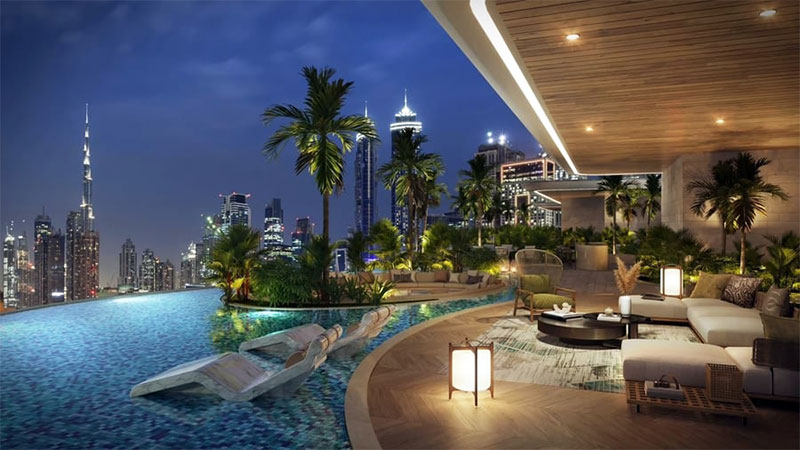
International luxury brands continue to expand their residential offerings in Dubai, where new developments combine high-end homes with hospitality, wellness, and lifestyle facilities.
One of the projects scheduled to open in late 2026 is Six Senses The Palm, Dubai. The development includes a 60,000-square-foot wellness club, adding an extensive health and wellness component to its luxury residential offering.
All residences in the project have already been sold. Plans also include the opening of a new ROKA restaurant, expanding the dining options available within the development.
Dubai-based property companies are also pursuing opportunities beyond the UAE.
Lamar Development, which has its headquarters in Dubai, is developing Casa Lamar Cedaceros 9 in Madrid, where demand for luxury residential properties continues to grow.
The project represents an example of a Dubai-based developer extending its activities into an international market while the emirate continues to attract global luxury brands to its own residential sector.
Middle East Leads Global Growth in Branded Residences
The Middle East has become a major center of activity in the branded residences market, accounting for a substantial share of both existing projects and future developments.
According to Knight Frank, the region represents 20% of all completed and under-development branded residential projects worldwide. Its share of the global development pipeline is even larger, at 25%.
The figures come during a period of considerable expansion for the sector internationally.
There are now approximately 1,800 branded residential projects either operating or under development across 90 countries. More than 200 brands are represented in the market, demonstrating how widely the concept has spread beyond its traditional hospitality roots.
The number of branded residential units worldwide is expected to exceed 300,000 by 2031.
The Middle East, particularly the UAE, accounts for a significant portion of this expansion, with new projects continuing to add to the region’s existing portfolio.
Abu Dhabi Strengthens Its Presence in the Luxury Real Estate Market
Abu Dhabi has established itself as another major UAE destination for branded residences, ranking eighth globally with 24 projects.
Of those, 19 are still under development, pointing to further expansion of the capital’s luxury residential sector.
The increase in branded residential projects comes as Abu Dhabi continues to develop its position as an international financial and business center.
The strength of its wider residential property market was demonstrated during the summer of 2026, when Modon sold 1,700 homes at its Hudayriyat Golf Estates development within just a few days.
The transactions were worth approximately AED 13 billion, with nonresident buyers accounting for 15% of all purchasers.
The sales highlight the presence of international buyers in Abu Dhabi’s luxury property market, alongside the continuing development of new residential communities across the emirate.
With most of its branded residential projects still in the development stage, Abu Dhabi is set to add considerably to its existing supply as those projects are completed.
Ras Al Khaimah Emerges as a Growing Destination for Luxury Residences
Ras Al Khaimah has also secured a place among the world’s ten leading branded residences markets, ranking ninth with 23 projects.
Much of the emirate’s luxury residential expansion is concentrated on Al Marjan Island, where new developments are benefiting from the growth of tourism and increasing international connectivity.
The report highlights a 44% increase in international flight traffic to Ras Al Khaimah between 2023 and 2026.
That was the highest growth rate recorded among the ten largest branded residences markets worldwide during the period.
The increase in international air traffic has accompanied the expansion of the emirate’s tourism industry and its growing portfolio of luxury residential developments.
Al Marjan Island, in particular, has become an important location for projects associated with international brands.
The combination of tourism growth and new branded developments has helped Ras Al Khaimah establish a stronger presence in the international luxury real estate market.
Fashion and Automotive Brands Expand Their Presence in Luxury Residences
The branded residences market is no longer dominated exclusively by hotel operators. Fashion houses, automotive companies, and lifestyle brands are taking a growing share of the sector, changing the composition of projects entering the market.
Hotel brands currently account for approximately 70% of operational branded residential developments worldwide.
However, their share drops to 60% when projects under development are included, reflecting the growing number of non-hotel brands entering the market.
The shift is expected to continue. Non-hotel brands are projected to account for around 40% of the total supply by 2028, up from 30% in 2025.
The UAE’s leading branded residences markets already demonstrate this change.
In Dubai, non-hotel brands account for 42% of branded residential projects, while their share stands at 38% in Abu Dhabi. On Al Marjan Island in Ras Al Khaimah, they represent 52%.
These figures show how fashion, automotive, and lifestyle companies are becoming increasingly involved in a sector traditionally associated with international hotel groups.
The growing variety of brands is also expanding the range of residential concepts available across Dubai, Abu Dhabi, and Ras Al Khaimah.